
 bwaugh
 December 15, 1763 the second son was born to the Baldwins of Newark, New Jersey. While the mother Mehetabel (a biblical name, Genesis 36:39, 1 Chronicles 1:50) rocked her baby she discussed with her husband, Jeremiah, the name of the weeping prophet, what would be the best name to give the lad. The one chosen was Methuselah, who was the father of Lamech and grandfather of Noah (Genesis 5:25-32). It is doubted whether Methuselah would pop into many minds today as a choice for a son’s name. There is not much more information available about the Bible’s Methuselah other than he was the son of Enoch who “begat sons and daughters” until his life ended after 969 years. The reason for the Baldwins’ name selection was not located, but the Bible’s Methuselah continued the seed of the woman that would bring Noah before successive begetters brought the only Begotten.
Methuselah’s father died when he was only twelve years old leaving Mehetabel struggling to pay the bills and train her children in the way they should go. Methuselah left home at the age of fifteen and came under the influence of some wayward youths leading him in a wanton life, but while attending church during the ministry of a Rev. Chapman he professed faith in Christ and shortly thereafter believed he was called to the ministry. But there was a problem. It was one experienced by other men whose biographies are on Presbyterians of the Past—a lack of funds to pay for education. The funding issues for seminary students would lead to the Presbyterians establishing, with much motivation for the action coming from the work of John Holt Rice, a fund for “poor and pious youths.” Faced with his funding challenge young Baldwin convinced the master of an academy in Orange, New Jersey to let him enter with the promise he would pay as soon as he could. Methuselah must have had a persuasive way about him. He completed preparatory studies then entered Queens College (Rutgers) in New Brunswick and finished the curriculum graduating with the class of 1789 alongside Jonas Coe and eight others. After graduation, he spent some time teaching at Elizabethtown to pay off his debts and commence theological studies for the ministry under the direction of Alexander McWhorter, who was the minister of First Church, Newark. Baldwin was licensed to preach the gospel by the Presbytery of New York, October 1791, then for a year he was a presbytery missionary supplying pulpits in the northern and western regions of New York. When the missionary term was completed, he was ready to accept a call from a church to become pastor.
The call came in 1792 from the Presbyterian church in the village of Pleasant Valley which is located about eighty miles north of New York City, but he had been leading worship there before the call because he married church member Jane Higgins in May before being ordained and installed pastor November 6. The installation sermon was delivered from Daniel 2:44 by John King, the pastor of the Upper West Conococheague Church in Lancaster, Pennsylvania.
And in the days of these kings shall the God of heaven set up a kingdom, which shall never be destroyed: and the kingdom shall not be left to other people, but it shall break in pieces and consume all these kingdoms, and it shall stand for ever.
Unfortunately, Jane died from complications caused by child birth leaving two infant children. After Pleasant Valley he moved to the church at New Windsor for his next call serving for about four years. He married his second wife, Julianna Evertson, during this time. When the Presbytery of Hudson first convened, November 17, 1795, Methuselah was one of the founding ministers and he was elected the first stated clerk. In conjunction with the New Windsor work he supplied various vacant churches within the bounds of presbytery. A church without a pastor was the Scotchtown church which issued him a pastoral call. After presbytery dissolved the New Windsor call, he was installed pastor of the Scotchtown church June 30, 1803. The congregation was small and unable to provide adequate financial remuneration, so he purchased a farm for additional income following in the spirit of Paul’s work as a tent maker. One member of the church observed that Baldwin was not avaricious, for him it was better to adjust his lifestyle to his income and pursue the great gain of godliness with contentment (1 Timothy 6:6). Methuselah’s experience growing up poor combined with struggles paying for his education must have taught him the lesson that God would provide.
He lived the remainder of his life with his family on the farm. Currently, Baldwin Hill Road accesses the property owned by the Baldwins. The farm had at least three houses built on the property because fire destroyed two houses in succession along with all the Baldwins’ possessions. By 1838, Methuselah had limited pastoral duties because the infirmities of age were catching up with him resulting in the elders hiring an assistant, Edward D. G. (Dorr Griffin) Prime. Prime had graduated Union College then Princeton Theological Seminary and would go on to edit the New York Observer after ending his ministry at Scotchtown. Baldwin delivered his retirement sermon from 2 Timothy 4:6-8.
For I am now ready to be offered and the time of my departure is at hand. I have fought a good fight. I have finished my course; I have kept the faith; henceforth there is laid up for me a crown of righteousness which the Lord the righteous judge shall give me at that day.
When Methuselah Baldwin died February 27, 1847, he was in his eighty-fourth year and the forty-fourth of his call to the Scotchtown congregation. He had been a minister for over fifty years. For his era, he lived a long life as did Methuselah of Genesis in his pre-diluvian context. Prime became Baldwin’s successor at Scotchtown and delivered the memorial sermon from Genesis 49:18 which is situated between Jacob’s blessings to Dan and Gad.
I have waited for thy Salvation O Lord.
Baldwin is buried in the Scotchtown Church cemetery with an obelisk marking the grave. During the Scotchtown years of service 427 individuals were admitted to the congregation on profession of faith. He had been a director for the American Tract Society for a number of years. No extant publications could be located.
Barry Waugh
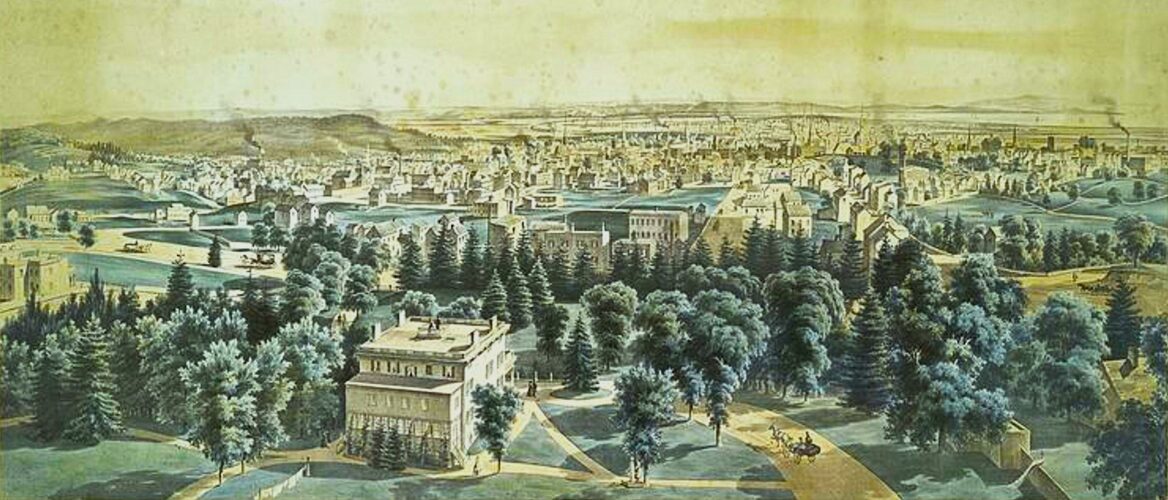
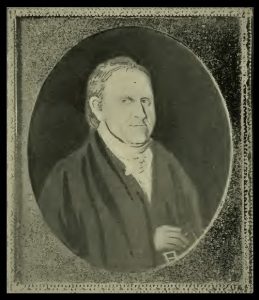
Notes—The header is from the New York Public Library Digital Collection and is titled, “Newark, N.J. from the residence of T.V. Johnson, Esqr.” Scotchtown, New York is thus named because its first settlers were from Scotland. The sources include, The Scotchtown Memorial; or, The Centennial of the Presbyterian Church of Scotchtown 1796-1896, Newburgh: E. G. Hulse, 1896, which also provided the portrait; and A History of the Presbytery of Hudson, 1681-1888, by Henry Addison Harlow, Middletown: Stivers, Slauson & Boyd, 1888, provides information for this biography that can also be accessed through Harlow’s source, “Memoirs of the Rev. Methuselah Baldwin,” in The Presbyterian, Vol. 17, No. 29 (July 17, 1847), p. 116; two partial columns of the page.