
 bwaugh
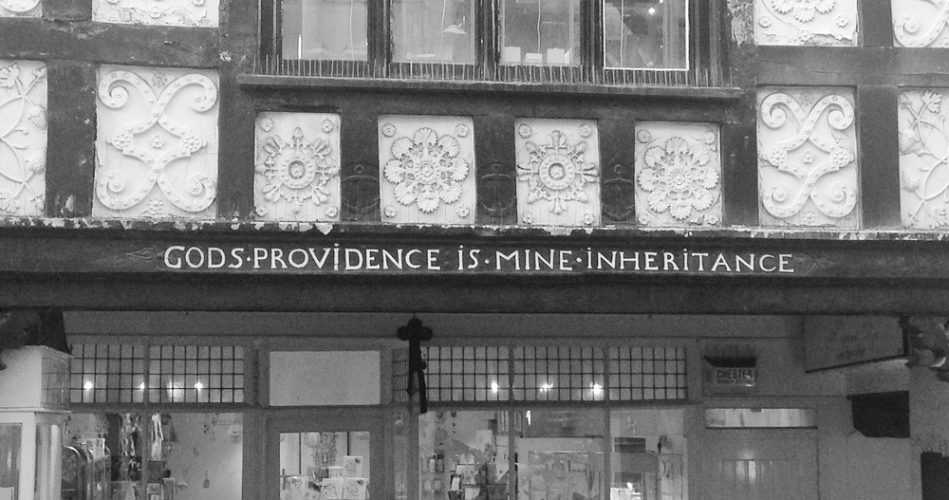
 The header image shows a house in Chester, England built in 1652. It is said the reason “God’s Providence is Mine Inheritance” was written on the bressummer is because the family that lived within the house survived a visitation of the plague during the latter half of the seventeenth century. The horrors of the plague and its painful death visited Europe often leaving behind masses of corpses ranging in age from newborn to elderly. This simple statement on the house that recognizes God’s providential governance of all his creatures and all their actions not only shows the family’s praise for preservation but also conveys the message of certain hope in the One who directs “his sun to rise on the evil and on the good, and sends rain on the just and the unjust” (Matthew 5:45). One of the important doctrines emphasized by the Reformation in England and on the Continent in the sixteenth century was divine providence, then a century later it was included as essential doctrine in the Westminster Confession of Faith, chapter 5. What is sad today is that many tourists wandering the quaint streets of Chester might pass this house and read the saying only to go on to the next site having no idea of who God is nor the significance of his providential work. The prevalence of evolution as THE doctrine of origins based on a chance universe has predisposed many to suppress the knowledge of God and his governing providence in unrighteousness. In the end, understanding that one is being cared for by God through providence is comprehended through the grace of Christ and growth in grace.
For those interested in the background of doctrines within the Westminster Standards there are some published editions of primary sources from the English Reformation provided by the Parker Society. The Society was named for Archbishop of Canterbury Matthew Parker (1504-1575) whose tenure extended from 1559 until his death during the reign of Elizabeth I. It was quite an accomplishment to be a cleric in sixteenth-century England and live without receiving a regent’s wrath in the form of exile, imprisonment, or execution. Parker and the Puritans did not get along when it came to the subject of vestments being used by the clergy, nor did the presbyterian and congregational Puritans accept his Church of England polity. But despite their differences, Parker, as testified to by his correspondence, interceded for Puritans with the queen. Parker had been attracted to the Reformation by Thomas Bilney (c.1495-1531) and Hugh Latimer (1485-1555) who both died at the stake for their teachings. More information about Parker is available at, “Archbishop Matthew Parker’s Pastoral Problem,” on this site.
The catalog of the fifty-five volumes of Parker series was compiled over the course of several years from examination of physical copies held by two theological seminaries and one university. The editor hopes the catalog will be of assistance because one of the purposes of this site is to provide resources for study of Presbyterian and Reformed history. Any one of the volumes cataloged below could be used for a student class paper, a source for a masters thesis, or when combined with manuscripts retrieved from archives could yield a dissertation. But then simply reading and learning is a good thing on its own. Included with the catalog is brief introductory material and reference to an article by Peter Toon about the Parker Society.
Download Catalog Parker Society Series on English Reformation
For information about the Great Plague of London in 1665-66, see the article about Daniel Defoe on Place for Truth, “Lord, Have Mercy on Us.” Chester was the city where Presbyterian minister Matthew Henry served a church for twenty-five years before moving to pastor briefly in London for his last call.
Barry Waugh