


 bwaugh
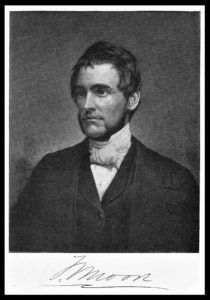 The tract “Why Are You Not A Communicant” was published without identification of the author, but he has been identified as T. V. Moore (1818-1871) by his son, T. Verner Moore (1856-1926). At the time he was senior minister of First Presbyterian Church in Richmond, Virginia, having previously served two churches in Pennsylvania. Page 12 of the Nineteenth Annual Report of the Board of Publication to the Old School General Assembly, 1857, described the tract as a new item having four pages. It was cataloged as item 192 with the first printing run including 2000 copies. Notice that Moore has targeted adults for this tract because he describes the individuals in question as “outside the visible Church.” He challenges those claiming to be Christians to show their commitment to Christ in a visible church by participating in the Lord’s Supper. For additional information about T. V. Moore, see on this site, “Essay on Juvenile Delinquency, T. V. Moore, 1855”; for his son, T. Verner Moore, see, “Michael D. Kalopothakes, Tenacious Missionary to Greece.”The header shows Richmond, said to be 1880 but looks earlier, and is from the New York Public Library Digital Collection.
Why Are You Not A Communicant?
[T. V. Moore, 1857]
You are convinced of the truth of the Bible, and the binding authority of its precepts. You believe the Christian Church to be a divine institution, and its ordinances obligatory. You believe that Christ issued a command that all should obey, when he said, “This do in remembrance of me” [1 Corinthians 11:24-25]. Why have you not obeyed it? Why are you yet outside of the visible Church? Let us examine some of the pleas commonly urged.
A man can be as good a Christian out of the Church as in it.
If so, why did Christ found the Church? Why did he make confession before men as obligatory as faith towards God? Can that man be a good Christian who disobeys Christ? And has not Christ enjoined a duty, which can be performed only within the Church? And, if you have never been in the Church, can you be a good judge of this question? But God has not left it an open question. He has required you to confess Christ before men, in this very way. Can you then be a Christian, and disobey this command?
I have no faith or obedience.
But are you not bound to believe and obey? And can the failure in these duties excuse the failure in that one? Can one sin justify another? Has not God offered you the grace needful to enable you to believe and obey? Can you plead your neglect of God’s offer as a plea for neglecting Christ’s command? Is not this simply an aggravation of your guilt, rather than an extenuation of it?
I am not certain that I am a Christian.
You are not asked to profess this fact, but simply to confess your faith in Christ, your sincere repentance of all your sins, your hope of acceptance through Christ alone, and your solemn determination, by the grace of God, to take up your cross and follow Christ. Are you ready to do this? If not, is not the particular in which you are not ready actually a sin?
I am unworthy to come to the Lord’s table.
But are you not unworthy to pray, to sing, to read the Bible, to hear the gospel? Are you not unworthy to live on God’s earth, breathe God’s air, and enjoy God’s bounties? But does this unworthiness prevent you from enjoying these privileges and attempting these duties? Why make this duty of confessing Christ and communing an exception?
I am, afraid I will bring reproach on the cause of Christ!
If you really are alive to the welfare of Christ’s cause, why not look at your present relation to it? Does not that injure it? Has not Christ said, ”He that is not with me, is against me” [Luke 11:23]. And is not your example urged against the cause of Christ, as far as it has any weight? You may be moral, upright, and blameless, but this very fact makes jour example more potent in proving that Christ’s institutions and commands are superfluous, in the estimate of the unbelieving. Your morality is placed to the credit of the world and the enemies of Christ, and used as a reproach against the Church. Ungodly men point to you as proof that there is more goodness out of the Church than in it. Are you not then even now bringing reproach on that cause? But are you sure that this is not pride? If you could be an eminent Christian, so that men would praise you for your piety, you would be willing to take the name. But as you may stumble and be a target for shafts [arrows, spears] of ridicule, you cannot bear to suffer this, even in trying to obey the commands of Christ. But is not that feeling pride? And is not pride a sin?
I cannot discharge the duties of a Christian profession!
Have you ever tried? How can you know then, until you try? Is it not better to try and fail, than to fail without trying? Is it not nobler to enter the battle and fall, than to be afraid to go on the field? But you do not go to warfare on your own charges, or contend in your own strength. God’s grace is sufficient for you, and his strength made perfect in weakness [2 Corinthians 12:9]. That strength, however, is not promised before duty, but in it. How can you then get it, if you never try to do the duty? And if you are weak now, when will you ever be stronger? Will you be nearer God the further you wander from him? Will your strength grow by weakening it in sin? Will you be better able, when you have quenched the Spirit?
There are many in the Church no better than I am.
But will their sin excuse yours? If they insult Christ in one way, may you insult him in another? Will you be the less surely lost out of the Church, because they may be lost in it?
But there are false professors enough.
You are not asked to be a false professor, but a true one, and the more false ones there are, the more it is necessary for true ones to exist.
I am not good enough.
And who is? And are you good enough to attempt any other duty? Why then make this an exception?
I do not feel worthy of this privilege.
If you did, you would probably be unworthy. Christ came not to call the righteous, but sinners to repentance [Luke 5:32]; not to spread a feast for the full, but for the hungry.
There is peculiar guilt in unworthy partaking.
But is there not peculiar guilt in refusing to commune? And who can assure you that the one is less than the other? Who can assure you that it is a smaller crime to neglect a duty wholly, than to try to perform it and fail?
I may eat and drink damnation to myself.
So, you will by refusing to eat and drink. The damnation or condemnation is the same in one case that it is in the other, only in trying to do your duty may you escape it, in refusing to try, you make it certain.
Then why are you not a communicant?