
 bwaugh
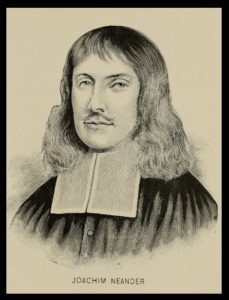 Joachim Neander was born in 1650 at Bremen, Germany. His father was a teacher in the local Latin school until his death when Joachim was only sixteen years old. He soon entered the Reformed University at Bremen to study theology in preparation for the ministry, but at the time, he saw ministry as simply a profession that would provide for a good future and job security, but his attitude would be changed. There was a movement in Germany that was gaining influence called Pietism. Pietists believed the existing Protestant churches in the land, both Lutheran and Reformed, were over emphasizing doctrine at the expense of personal experience and practical Christian living.
James I. Good expressed the situation as follows:
Two causes led to the development of Pietism in the Reformed Church in the close of the seventeenth century. The first was a reaction against the dead orthodoxy and formalism that had crept into the Church. The second was the rise of the Cocceianism, or the Federal School of Theology. The two really were one, Cocceianism a reaction against deadness of doctrine, and Pietism a reaction against deadness of life. Through the theological controversies religion had become a matter of the head, rather than of the heart and life (314-315).
Pietism began among the Lutherans then spread to the Reformed Church. One Sunday in the fall of 1670, Neander went to hear Theodor Untereyck (1635-1693) preach with the intention of making fun of his teaching, however, he instead was convicted of his hardness of heart and foolish practices. He came to faith in Christ. After the service he left the church and mentioned to the two friends with him that he had decided to follow Christ. Neander continued to attend Untereyck’s services and became a follower of his teaching. Neander’s ideas concerning life and the ministry had completely changed.
The spring of 1671, he accepted an offer from some French Reformed (Huguenot) families in Frankfurt to take their five sons about sixty miles south in Germany to the University of Heidelberg. It was not unusual for parents with means to hire someone to chaperone their boys and keep them out of trouble while away at university, but handling five young men must have been particularly challenging. Nevertheless it was a good opportunity for Neander because he could study in the Heidelberg facilities while tutoring and watching the boys until they returned to Frankfort in 1673.
Continuing with his pietist interest, the next year Neander participated in private Bible study and prayer meetings in Frankfurt led by Philipp Jakob Spener (1635-1705). Spener opposed what he believed were the rigid organization and doctrinal inflexibility of Lutheranism while also condemning the lax morality of many of its clergy. Neander became more deeply associated with the pietist movement and found Spener’s teaching a continued source for learning from Untereyck. Neander’s most significant work during the years in Frankfort was writing hymns. As the pietist movement grew it increasingly drew German adherents from Reformed as well as Lutheran backgrounds. Some Lutherans sang Neander’s hymns in prayer meetings and as pietism came to influence the Reformed they also used his hymns.
In 1674, Neander became headmaster of the parochial school started by the Reformed Church in Dusseldorf. He assisted the master, surnamed Lürsen, with duties even though he was not officially an assistant. Neander was still a theological student and he would continue as such until his death; his status seems to correlate with the current definition of Presbyterian licensure which allows ministerial work under presbytery oversight. Giving boost to the pietist movement, Spener published in 1675, Pia Desideria (Pious Desires), which became the manual for pietist practices as the movement spread on beyond Germany and the Netherlands into Scandinavia. Neander and Lursen worked well for a time but as the former became more popular with the congregation, the latter came to resent his colleague. Lursen, it is believed, began speaking against Neander and his theological views. Added to this tension was Neander refused to adopt the order of the Reformed Church and he would not subscribe to the Heidelberg Catechism. He was censured by the Presbyterium (similar to a presbytery) in October, 1676, and added to the charges concerning his church ministry were accusations regarding his operation of the school. At the school he developed and was using his own curriculum without having it approved by the Presbyterium; he rescheduled examinations without approval; and he made repairs to the property without either approval or funds. These were the main points against him. The Presbyterium presented a declaration to Neander, February 3, 1677, suspending him from directing the school and forbidding him from preaching in the church. The declaration required him to subscribe to the Heidelberg Catechism and the order of the Reformed Church; condemn attempts to separate from the church as in pietist conventicles; and promise not to hold private prayer meetings without first having the approval of either the pastor or the Presbyterium. The issue for Neander was simple—would he work within the Reformed Church and follow its standards? Having been admonished by the brethren, he signed the declaration and was allowed to return to his duties.
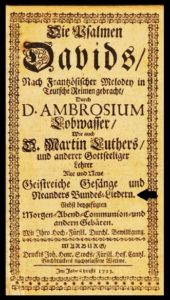 Neander was allowed to resume teaching the students in the school at Dusseldorf while continuing ministry in the church with Lurson. Perhaps seeing the handwriting on the wall or simply unable to continue, Lurson resigned his call in June 1677. Within months Neander accepted an opportunity to assist in St. Martin’s Church, Bremen, 1679, where his mentor Untereyck was pastor with Cornelius de Hase, who was also professor of theology at Bremen University. The new call was a return to the church where Neander had committed himself to Christ. He began July 1679 with his duties including occasional preaching; filling in if Untereyck or de Hase was sick; and leading the services held at 5:00 in the morning on the Lord’s Day. Neander published the first hymn book of the Reformed Church of Germany Hymns of the Covenant, 1679. The Reformed churches had worshiped historically singing the Psalms, but Neander’s hymns contributed changing from exclusive Psalmody. Neander followed the Reformed custom of printing the melodies with the hymns and composed some of the melodies himself, as Luther had done.
Joachim Neander did not live long. Within a year of publishing Hymns of the Covenant he became very ill for several days before dying, May 31, 1680. During his decline he found encouragement and assurance from Hebrews 7-10 when they were read to him. The chapters’ emphasis on the superiority of the New Covenant over the Old gave him hope and assurance as he anticipated death. His last words were Isaiah 54:10.
For the mountains shall depart and the hills be removed, but My kindness shall not depart from thee, neither shall the covenant of My peace be removed.
He died on Pentecost. He had been called to Bremen on the same day the previous year. Untereyck preached on the following Sunday a memorial sermon from the third chapter of John.
Neander wrote many hymns but popular with Presbyterians is “Praise to the Lord, the Almighty,” (53, red Trinity Hymnal). I sang this hymn in worship yesterday and the note of Neander’s authorship at the bottom of the page reminded me of the challenges he faced as he came to minister for the Reformed Church. Neander’s life shows that even when the Christian wanders, the grace of forgiveness brings renewal of purpose that can lead to beneficial ministry even if it is just for a handful of years. There is a portrait of Neander in Dusseldorf that has written beneath it, “Immovable in the Lord.” The only other hymn by Neander in the red Trinity Hymnal is, “Wondrous King All Glorious,” 166.
Barry Waugh
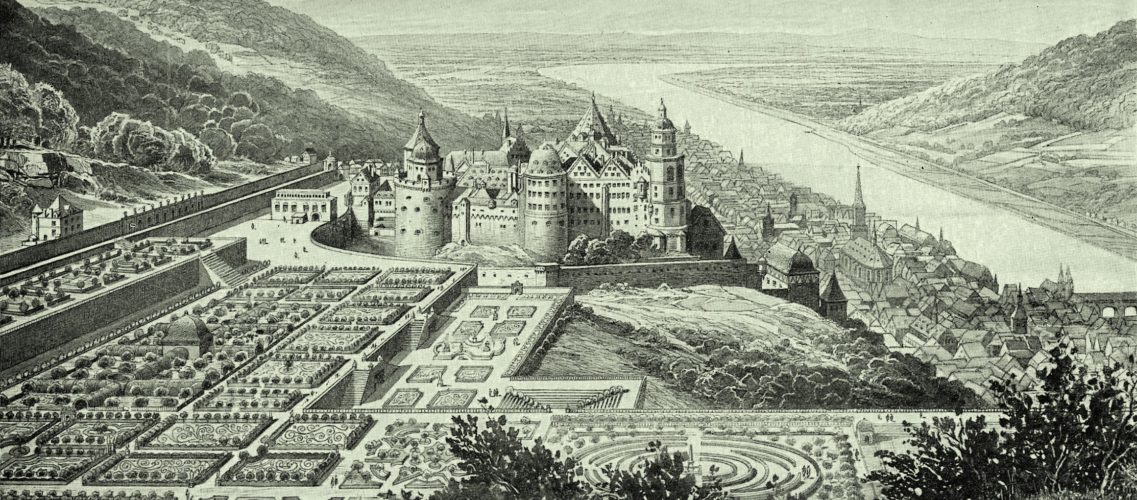
Notes—The header showing Heidelberg Castle is from Wikimedia Commons as found in, H.F. Helmolt, History of the World, Volume VII, Dodd Mead 1902; the picture is between pages 290 and 291; Heidelberg Castle had some of its foundations laid in the 11th century and was destroyed by fire after having been struct lightning in 1764. The title page image is for a book published in 1723 that includes an edition of Luther’s Psalms, and a copy of Neander’s Hymns of the Covenant. The primary source and the sketched portrait were taken from James I. Good, History of the Reformed Church of Germany, 1620-1890, Reading: Daniel Miller, 1894, 344-362. Also helpful was J. H. Dubbs, “Early German Hymnology of Pennsylvania,” Reformed Quarterly Review 27, issue 4, Oct. 1880, 504-524. Also used was E.E. Ryden, “Joachim Neander: The Gerhardt of the Calvinists,” in The Story of Christian Hymnody, Rock Island: Augustana Press, 1959, pp. 109-114. See also, William J. Hinke, “The Early German Hymn Books of the Reformed Church in the United States,” Journal of the Presbyterian Historical Society 4, no. 4 (Dec. 1907), 147-161; this article describes the first seven hymnbooks, 1753-1842, with their translated German titles followed by brief comments. Also, written in German is, Reinholdus Vormbaum, Joachim Neander’s Leben und Lieder (Joachim Neander’s Life and Songs), Elberfeld: Martini & Grüttesien, 1860.