
 bwaugh
 Robert Davidson was born in 1750 near the Elk River in Elkton, Maryland. His early education prepared him for the College of Philadelphia (University of Pennsylvania) where he graduated 1771 during the administrative tenure of Francis Alison (Old Side Presbyterian). The next year Davidson was licensed to preach and was appointed an instructor in the college until becoming professor of history. John Ewing, the minister of First Presbyterian Church and a faculty colleague, became a close friend. Ewing needed help with his ministry to First Church, so Davidson was called and was ordained by the Second Presbytery of Philadelphia to become his assistant. Ewing saw in Davidson a man of varied interests and successfully sponsored him for membership in the American Philosophical Society in 1783. Davidson was a capable scholar with facility in nine languages, and within the city he was greatly respected for his ministerial and intellectual gifts as well as ability to lead.
To the west of Philadelphia, Dickinson College was getting underway and the trustees were searching for personnel to teach and direct administration for the new institution. The college had been chartered through the persistent work of physician and founding father Benjamin Rush, 1783, who hoped to find for Dickinson a man with qualifications similar to those of John Witherspoon at Princeton. Rush believed a college further to the west was of paramount importance as pioneers settled the frontier. Dickinson is named for founding father John Dickinson and it is the first college established in the United States (i.e. not the Colonial era). The candidate filling the position needed a breadth of knowledge to teach a variety of topics including geography, chronology, rhetoric, and belles lettres (literature), to which natural science would be added later. Ewing thought Dickinson was a good candidate and after some encouragement, he accepted the appointment. He left Philadelphia for Carlisle in 1784 but not before the College of Pennsylvania trustees showed their appreciation for his thirteen years of work by honoring him with the Doctor of Divinity.
Davidson’s move to Carlisle soon provided the opportunity to serve as professor-pastor as he had done in Philadelphia. The First Presbyterian Church desperately needed a minister because its previous minister, John Steel, had passed away more than five years earlier and a suitable candidate had not been located. Contributing to the pastoral search problem was division within the congregation. When Steel died in 1779, First Church, because of a stipulation resulting from the Old Side-New Side division of the Presbyterian Church (divided 1741-1758) had to change its presbytery membership from Second Presbytery of Philadelphia (Old Side during the division) to the Presbytery of Donegal (New Side during the division). First Church had met in two meeting houses with the Old Side served by Steel and the New Side by George Duffield. At one point during the division, the two groups shared the courthouse for worship with each group meeting at different times on the Lord’s Day. Since reunion, the congregation worshipped in a single gathering but a lack of singlemindedness was hampering the search for a pastor.
Davidson’s move to Carlisle provided First Church with a candidate the congregation could accept. Dickinson College and First Church enjoyed a close relationship because its faculty and students would attend services and contribute to the work of he church. Carlisle was a decidedly Presbyterian town as Conway P. Wing observed commenting that the village was “the strongest and most compact body of Presbyterians in America … then and was likely to be for some time in this region” (119). Carlisle was not only a settlement for Presbyterians but also the geographic point where many Scotch and Scotch Irish immigrants would turn south in their journey to settle along the Shenandoah Valley in Virginia, eastern Tennessee, the Carolinas, and Georgia. Davidson was offered and accepted a pastoral call, but first his presbytery membership had to be transferred to the Presbytery of Donegal as recorded in the minutes, April 12, 1785.
The Rev. Dr. Davidson, having accepted a call from the First Church of Carlisle and now having settled in that place, produced a certificate of his dismission from the Second Presbytery of Philadelphia and applied to be received as a member. He is accordingly received and takes his seat.
John Montgomery, an elder from First Church, asked the moderator to appoint a committee to install Davidson, which included Robert Laing and Samuel Waugh to lead the service set for April 27. Davidson was set to fulfill his callings in Carlisle with a lectern at one hand and a pulpit at the other.
But there was another factor in addition to the remnants of division at First Church affecting Davidson’s work and it was associated with Dickinson College.
In July, 1785, Charles Nisbet arrived from Scotland to become the first principal (president) of Dickinson College. But before beginning duties that fall, he and his family were stricken with illness. He thought the Carlisle climate was too challenging for his constitution, so he resigned with the hope of returning to bonnie Scotland. Dickinson needed a leader, so Davidson performed the duties of principal in addition to his already heavy load of teaching and preaching. The Nisbets were delayed for months in their return home and in the mean time had recovered from sickness leaving Nisbet to decide to stay in Carlisle. He wanted to keep the Dickinson principalship, so he was rehired. A potential problem for Davidson at First Church was Nisbet shared the pulpit with him half time for both morning and evening services, but Davidson was left to do all the pastoral work. Added to this was a promise to George Duffield by the church that he could preach on occasion. Three ministers sharing the pulpit created an opportunity for congregants to possibly favor one over the others which could result in factions, but it appears the church, Nisbet, Duffield, and Davidson got along well and the ministers were able to effectively share worship leadership. However, when the Whiskey Rebellion over taxation of spirits took place in 1794 in the western part of the state, Davidson, one Sunday morning carefully spoke of the duty the people had to express their views in constitutional ways while submitting to the powers that be; it was not a popular sermon for some in the congregation, but not too many feathers were ruffled. Then when Nisbet preached on the same subject using 1 Thessalonians 4:11 for his text, he spoke more bluntly of the people’s duty to mind their own business and work with their hands in their occupations and leave the law making to the government—the sermon did not go over well with some congregants complaining that Nisbet echoed the tyranny of George III that seeded the Revolution. But despite different methods in their sermons, Davidson and Nisbet both agreed that the people needed to obey the law.
When Nisbet died in 1804, Davidson delivered the memorial sermon and became president of Dickinson pro-tem until another president was located. He turned down the presidency as did Samuel Miller but a new principal was found in Vermont at Middlebury College, its president Jeremiah Atwater. The new administration provided Davidson the opportunity to resign from all teaching and other responsibilities at the college and dedicate his time to serving First Church.
His preaching displayed the breadth of his interests because he often used scientific and historical illustrations in his sermons that were read from manuscripts, but they never exceeded an hour, even if he had to stop midsentence (this is according to his son who was four when his father died). Despite Davidson’s lack of pulpit skills he had a presence and bearing in the pulpit, he fostered respect among the people, and he was a congenial shepherd at First Church. The children of the congregation were a particular joy for him as they became his own. Davidson and his first wife were unable to have children, but he did become a father when his second wife delivered a son. As was the norm in the day for Presbyterians influenced by Scottish practices, he catechized the church children according to age groups each week.
He was a good minister but science increasingly drew his attention. Astronomy fascinated him and some of his research led to him publishing scientific papers. One of his interests resulted in fabrication of an apparatus called a compound globe which he named a cosmosphere. It was some type of three-dimensional model of the solar system or the universe.
Davidson participated in the Presbyterian judicatories at all levels including the Synod of Philadelphia where he was moderator in 1795. Then in 1796, the General Assembly met in Philadelphia but was poorly attended and brief for the era, less than five days. Davidson was elected moderator. Issues that came before him included: the inability of the Synod of Philadelphia to obtain a quorum in 1795; continuing to improve relations with the General Association of Connecticut (Congregational); the publication of a new edition of the Constitution of the Presbyterian Church; a controversial overture which was tabled that attempted to have a Presbyterian hymnal compiled from existing ones; and discussion of a change to the Form of Government that would facilitate the assembly meeting every three years by having synods take up more of the load. When he returned to Philadelphia for the Assembly the next year his moderator’s sermon was delivered from Psalm 72:17,
His name shall endure forever; his name shall be continued as long as the sun; and men shall be blessed in him; all nations shall call him blessed.
Robert Davidson, D.D., died on the Sabbath, December 13, 1812, of “dropsy in the chest, after protracted agonies.” Dropsy is the accumulation of fluid in a part of the body. His memorial sermon was preached by his friend and ministry colleague, Robert Cathcart, and was published bearing the title, A Sermon on the Death of the Rev. Robert Davidson, D.D., who died December 13th, 1812: Preached in the Presbyterian Church in Carlisle, February 28th, 1813. The delay in the memorial service may be indicative of a cold Pennsylvania winter and hard ground. He is buried in what is currently called the Old Graveyard in Carlisle where he is memorialized on a recently installed bronze plaque as a patriot with other men who contributed to the American Revolution, but on his grave marker he is remembered as “A Blessed Peacemaker.”
Davidson’s written works include: Psalm 119 in meter bearing the title, The Christian’s A. B. C.s, published 1811, and the next year saw released, A New Metrical Version of the Whole Book of Psalms; in Various Measures, More Free, Plain and Harmonious, and More in the Language of the New Testament, than Former Translations, with Occasional Notes and Illustrations, Carlisle: Printed by Alexander & Phillips. He also wrote a geography book titled, Geography Epitomized, or A Tour Round the World: Being a Short but Comprehensive Description of the Terraqueous Globe, Attempted in Verse, for the Sake of Memory, and Principally Designed for the Use of Schools, 1784, which was reprinted several times to at least 1812. His memorial sermon for George Washington was published but locating a copy proved elusive. Davidson preached to General Washington and his troops at the Carlisle Barracks during the Whiskey Rebellion.
He left twenty volumes of manuscript sermons and scientific lectures which are partially or fully held by Dickinson College Special Collections (very informative website). During his twenty-seven-year ministry in First Church, 498 individuals were admitted to the church with 330 of them added on profession of faith. According to his own notation, the membership in 1812 was over two hundred. Robert was survived by his like-named son and his third wife, Jane (Harris) Davidson. He was first married to Abigail for over thirty years until she was killed when her carriage overturned in 1806, and his second wife, Margaret Montgomery, passed away in 1809, likely as the result of child birth.
Barry Waugh
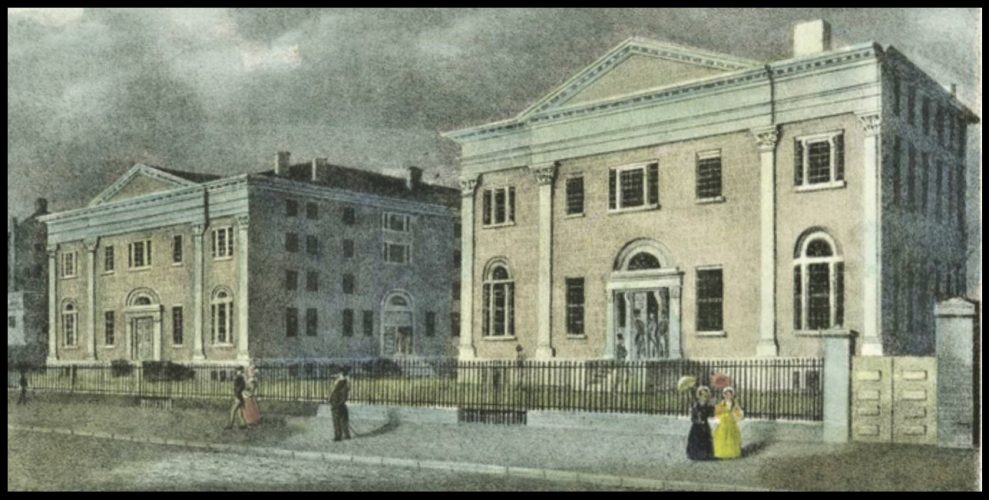
Notes—The header is a view of some University of Pennsylvania buildings. It looks mid-nineteenth century and is from the New York Public Library digital collection. Some information about Davidson and Dickinson College in particular was located in Charles Coleman Sellers, Dickinson College: A History, Middletown: Wesleyan University Press, 1973; and Horatio C. King’s, History of Dickinson College, New York: The American University Magazine Publishing Company, 1897. The Dickinson College web page, “Presidents, 1783-1833,” was used for both Davidson and Nisbet. One biography was written by his son Robert and is in William B. Sprague’s Annals of the American Pulpit, vol. 3, Presbyterians, 1858, pages 322-26. Another story of his life is available in Alfred Nevin’s Centennial Biography: Men of Mark of the Cumberland Valley, PA. 1776-1876, 1876, pages 112-13. Conway P. Wing wrote about Davidson in A History of the First Presbyterian Church of Carlisle, PA., 1877 on pages 116-48. Another biography is available in The Centennial Memorial of the Presbytery of Carlisle, vol. 1-Historical, vol. 2-Biographical, 1889; vol. 1 provided Davidson’s portrait. Davidson’s son’s biography in Sprague is revised in Centennial Memorial to provide a more generous perspective on dad. Another helpful title is by Allan D. Thompson, The Meeting House on the Square, Carlisle, 1964, which is a history of First Church. Samuel Miller wrote, Memoir of the Rev. Charles Nisbet, Late President of Dickinson College, Carlisle, New York: Robert Carter, 1840. See the post, “The Tennent Family and William Mackay Tennent,” regarding the common use of the same given name for the descendants in a family and the need for care when reading sources.