
 bwaugh
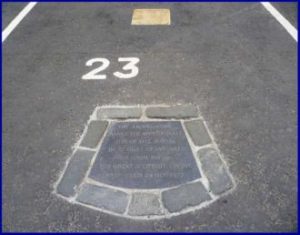 Once again it is October and remembrance of the Reformation will occur at the end of the month. For this post a mix of items relevant to Scotland and the Reformation are provided. The most significant is a brief presentation of a portion of the book Stirling Presbytery Records 1581-1587. The picture of parking lot space 23 shows where the grave of Knox is believed to be located in the blacktop covered church yard of St. Giles Church. The marker surrounded with pavers reads, “The Above Stone Marks the Approximate Site of the Burial in St. Giles Graveyard of John Knox the Great Scottish Divine Who Died 24 Nov 1572.” The stone referred to does not appear to have an inscription. On the one hand it is good the grave is marked and protected, but on the other hand it seems unsympathetic to cover any grave with asphalt. Fortunately, from what I could tell, the cemetery was relocated except for Knox’s grave.
Header Image
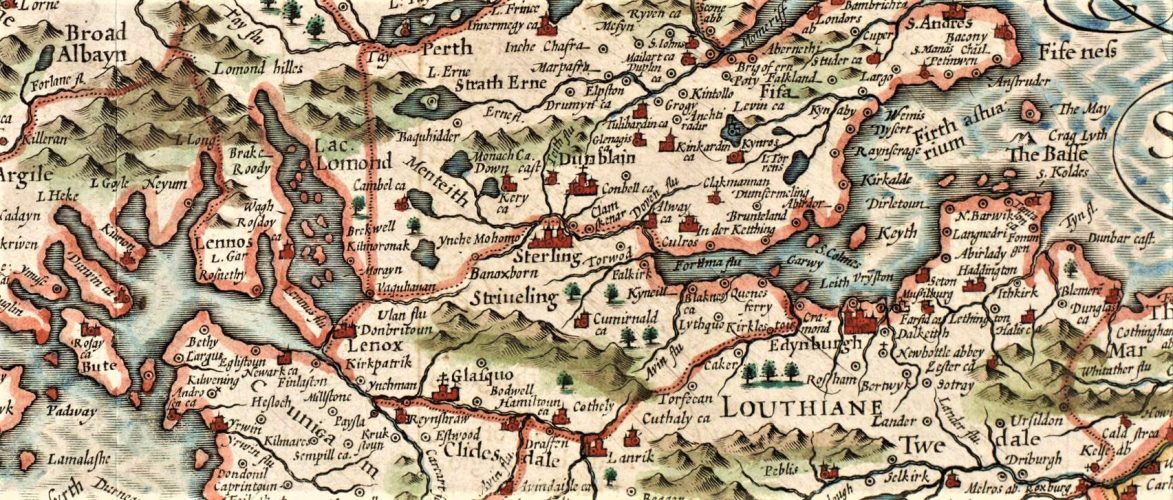
The National Library of Scotland has several hundred digital maps dating 1558-1947 with about two hundred selections composed before 1800. The map portion in the header is from “The Kingdome of Scotland” by John Sudbury and George Humbell, 1610. The original map measures 14.45 x 17.95 inches (367 x 433 millimeters). On the left and right sides of the map are pictures described as King James of Great Britain, France & Ireland; Henry, Prince of Wales & Ireland; Anne, Queen of Great Britain, France and Ireland; and Charles, Duke of York and Albany. It is scaled with Scottish Miles which is equivalent to 5,962 English feet. The selection is a beautiful example of cartography that presents Scotland at a transitional point in its history with King James of Scotland ruling Great Britain. During his reign the Authorized Version (KJV) was published in 1611.
Presbytery Records
Antiquarian presbytery records are difficult to find for American Presbyterianism and records for the Kirk in Scotland are even less accessible here in the States, but the Scottish History Society published in 1981, Stirling Presbytery Records 1581-1587, as edited by James Kirk. Dr. Kirk’s introduction is informative as it provides perspective, context, and summary of the records. In 1581 the General Assembly resolved to establish thirteen presbyteries. Scotland is just over 30,000 square miles in size which makes it just a bit smaller than its comparable state, South Carolina. There are Scotts descendants in South Carolina that surely enjoy the similarity of size between the Palmetto State and the Thistle Nation. Stirling Presbytery was first called to order August 8, 1581, by Robert Montgomerie and Andro Grahame who had been appointed conveners by the Assembly. Eight ministers and nine elders were present. In the records Stirling is spelled “Strivling” and on the map the fort is spelled “Sterling” while the region is “Striueling.” These spelling difference are indicative of variations in the minutes which include words from and derivatives of Latin, Gaelic, Old Scots, and English as well as some in French. Some portions of the transcription are challenging. Along with the different languages used the variety of spellings of the same word can also be due to the clerk receiving information auditorily or possibly on scraps of paper with each person communicating having their own accents, emphases, and spellings. The quote that follows is from a list of charges against a minister with the given name James.
Thridlie, being accusit for mareing of ane Agnes Kidstoun (hir husband [blank] beand on lyf and na divorcement passit betuix thame) with ane Johnne Broun, the said James confessit the mariage, bot denyit that he knew hir first gudman to be on lyve.
Modernized the statement reads as follows:
Thirdly, accused of marrying Agnes Kidstoun (her husband [space for his name] is still alive and they are not divorced) with Johnne Broun. The said James confessed [doing] the marriage, but denied that he knew her first husband was alive.
For this article only a selection of text was read that extends from August 1581 to April 9, 1583. Note that if you decide to read the minutes, the new year began on March 25. The issues before Stirling Presbytery were overwhelmingly concerned with marriage. There are cases of bigamy; at least two cases of paternity; one case of a wife either not consummating her marriage or breaking her betrothal; children born because of fornication or adultery; how baptism was to be handled when a child was born from a sinful relationship whether adultery or fornication; and one case that was called adulterous until the man proved he was not married at the time he had relations with the single woman in question, thus yielding fornication rather than adultery. At some meetings as many as four or five new or continuing marriage cases were addressed. Some of the people repented, but others did not. Excommunication was common and the policy was anyone excommunicated could not be spoken with by members in good standing; the excommunicated were ostracized. In the case of discipline administered to Robert Montgomerie (Montgomery), the same minister involved in organizing Stirling Presbytery and pastor of the Stirling church, considerable time was spent dealing with discipline of him including dereliction of duty, theological issues, and other charges that eventually ended up with him being excommunicated (for more see, Dictionary of Scottish Church History & Theology). Two men were confronted for having spoken with Montgomerie socially and they both repented. Given the prominence of the Sabbath in Presbyterian history one might think there would have been several cases of Sabbath violation, but of the records read, there was only one case and it occurred towards the end of the section. One of Stirling Presbytery’s duties was admission of ministers to their churches but in a few cases admissions were delayed due to the inability of transferees to obtain their credentials in time for the presbytery meeting. Stirling Presbytery reviewed church records and presbyters would informally visit churches, but the practice was formalized officially in April 1583 when presbyters were first appointed to visit churches regularly. Also, visitation occurred when an issue arose in a church as was the case when a minister complained that his congregation would not provide him a livable house.
The presbytery meetings themselves were different from what one would see today. The moderator was elected to serve a six-month term and it appears meetings were held as needed—i.e. called meetings in today’s terminology. It might be thought that a moderator would lead three or four meetings during his tenure, but for the six months extending from August 8, 1581 there were twenty-three meetings yielding nearly weekly gatherings. Often, there were only one or two actions, so meetings could be brief. Considering the map above, Dunblain, which is close to Sterling, became its own presbytery, so it can be seen presbytery bounds were small, and in some cases isolated. Presbyteries were made up of several parishes served by the individual churches. Going to a presbytery meeting meant presbyters did not have to travel more than a few miles. It does not appear the Kirk was so concerned about the bounds of presbyteries as it was about their centers; whether an area without a church was within presbytery bounds was not significant because if a new church in a new region was established, others would follow yielding a center for a new presbytery. An interesting practice was when elders attended presbytery for the first time, they were sworn in as commissioners. Another practice for a short time was each minister would tell his fellow presbyters what his current preaching series was about. It was often noted that presbytery was acting at the instruction of the General Assembly and there were decisions resulting from adoption of the Second Book of Discipline in 1578. The tendency is to think that presbytery meetings have always been pretty much as they are now, but reading the old Stirling records shows that things have changed over four centuries.
If you are interested in how the presbytery as we know it developed, it would be worthwhile to read James Kirk’s transcription of the records of Stirling Presbytery. In some places it can be difficult to figure out what is being communicated, but I found that skipping over the cryptic and going on to the more interpretable was the best approach to provide experience for another look at the cryptic portions later Marking the cryptic portions in some way to return for a new reading after more experience with deciphering the records is an effective method.
Books about Scotland, Presbyterianism, and the Reformation
Collins Encyclopedia of Scotland, edited by John Keay and Julia Keay, New York: Harper Collins Publishers, 1994, is a general reference book but it includes some church history that is not provided in the next title.
Dictionary of Scottish Church History and Theology, edited by organizing editor Nigel M. de S. Cameron, and general editors David F. Wright, David C. Lachman, and Donald E. Meek, was published by T. & T. Clarke in Edinburgh, 1993, and by InterVarsity in Downers Grove, 1993. This resource was a monumental accomplishment and understanding of not only the religious history of the nation but Presbyterianism are enhanced by its publication.
Hay, George, The Architecture of Scottish Post-Reformation Churches, 1560-1843, Oxford: Clarendon Press, 1957. This is a fine study and is well illustrated to show the nuances of design. Emphasis is placed on, as one would expect, the centrality of the pulpit. Church building committees concerned for architecture that represents the solas and their affect on design will find this helpful, but it is scarce, so anyone interested in seeing a copy could try the local library and borrow it via inter-library loan. Pastor Terry Johnson of IPC, Savannah, introduced me to this book and I have found it helpful.
Hetherington, William M., History of the Church of Scotland from the Introduction of Christianity to the Period of the Disruption in 1843, New York: Robert Carter & Brothers, 1856. The author was a minister of the Free Church of Scotland who was educated at the University of Edinburgh. In addition to History he wrote History of the Westminster Assembly.
History of the Free Presbyterian Church of Scotland, 1893-1970, Compiled by a Committee Appointed by the Synod of the Free Presbyterian Church and published by the Publications Committee, Free Presbyterian Church of Scotland, [1973?]. From the dustjacket: “This history is the record of the stand and contendings for scripture truth of a Church which claims to be directly descended from the Scottish Church of the Reformation.”
Kirk, James, editor, Stirling Presbytery Records, 1581-1587, Edinburgh: Printed for the Scottish History Society by Clark Constable, 1981. This is the book that was discussed above.
Knox, John, The History of the Reformation in Scotland, is a first-hand account by the prime mover of Presbyterianism in Scotland and it is currently available in paperback from Banner of Truth. Banner also offers The Works of John Knox in a six-volume clothbound set. Without assessing the perspectives of each of these biographies of Knox, here are a few available: Thomas M’Crie, Life of John Knox, 1854; Jasper Ridley, John Knox, published by Oxford in 1968; and Jane Dawson’s 2016 biography published by Yale with the title John Knox, which Sean Michael Lucas describes as a “sympathetically critical treatment” and “a joy to read” (as on the Yale site).
Macleod, Donald, Therefore the Truth I Speak, Christian Focus Publications, Mentor, 2020. The book collects lectures delivered by the author who was Principal of the Free Church of Scotland College, Edinburgh until 2010 and passed away in 2023. Subjects covered include: Patrick Hamilton, George Wishart, John Knox, Andrew Melville, the Second Book of Discipline (adopted 1578), Robert Bruce, Samuel Rutherford, David Dickson, Federal Theology, and Robert Leighton “Episcopal Calvinist.”
M’Crie, C. G., The Confessions of the Church of Scotland, Their Evolution in History, The Seventh Series of the Chalmers Lectures 1906, Edinburgh: Mcniven & Wallace, 1907. Notice that 1647 is the year the Westminster Confession was approved by the General Assembly of the Church of Scotland on August 27. The six lectures are: “Symbols of the Church of Scotland Prior to 1647”; “The Westminster Confession of Faith”; “Westminster Teaching in the Light of Federalism, Mysticism, and Universalism”; “Westminster Teaching Affected by Movements Evangelical, Scientific, and Critical”; “Readjustments of Scottish Confessions as Exhibitions of the Existing Faith, and as Bonds of Agreement and Adherence”; and finally, “Reconstructions of the Confessional Theology of Scotland Subsequent to 1647.”
Summary of the Testimony of the Reformed Presbyterian Church of Scotland, Glasgow: James Hedderwick & Sons, 1932, not only provides the material mentioned in the title but also a list titled, “Scots Worthies,” from Patrick Hamilton, burned 1528, to John Macmillan, died 1753. There is also a nice diagram of “Scottish Presbyterian Churches, 1560-1929” showing the ancestry of divisions and unions leading up to the Reformed Presbyterian Church.
Todd, Margo, The Culture of Protestantism in Early Modern Scotland, New Haven: Yale University Press, 2002. What a fascinating book! Some of the practices Presbyterians hold to as traditional may not be so traditional. I use both this book and George Hay’s in the Church Design series on this site and they are particularly important for the article, “Designing Churches–Seating.” See the author’s entry on the “Penn Arts & Sciences Department of History” site.
Walker, James, The Theology and Theologians of Scotland, 1560-1750, Edinburgh: Knox Press, 1982 reprint of 1888 second edition. Donald Macleod supplied the publisher’s introduction. The seven chapters are titled: “Survey of the Field,” “Predestination and Providence,” “The Atonement,” “The Doctrine of the Visible Church,” “The Headship of Christ and Erastianism,” “Present Misrepresentation of Scottish Religion,” and “Do Presbyterians Hold Apostolical Succession?”
Warrick, John, The Moderators of the Church of Scotland 1690-1740, Edinburgh: Oliphant, Anderson & Ferrier, 1913. After the introduction titled, “Some Features of the Revolution Church,” there are biographies of twenty-seven moderators with portraits of six. The moderators are: Hew Kennedie, William Crichton, John Law, Patrick Simson, George Meldrum, George Hamilton, David Blair, Thomas Wilkie, David Williamson, William Carstares, William Wisheart, John Stirling, John Currie, William Mitchell, William Hamilton, James Grierson, Thomas Black, James Smith, James Alston, Neil Campbell, John Gowdie, James Gordon, Alexander Anderson, Lauchlan M’Intosh, James Ramsay, James Bannatine, and George Logan.
Some Links for Further Information
For John Knox from a different perspective see Wayne Sparkman’s “The Love Life of John Knox (1564): Considering the first and second marriages of John Knox.”
There are several videos of the John Knox House in Edinburgh, but “John Knox House–Virtual Tour 2020” is 7.5 minutes, well narrated, the photography is quite good, and is fair to the memory of Knox. The narrator describes books, documents, and other items on display and the significance of Knox for Scotland and Presbyterians. It is interesting that the house is above the commercial ground level which in Knox’s day was divided into booths that were used by tradesmen and vendors to sell their services or goods. I think this video may have been filmed by the entity that operates the house.
John Knox’s church in Edinburgh is St. Giles’ Cathedral. The church’s history page is HERE.
Barry Waugh