
 bwaugh
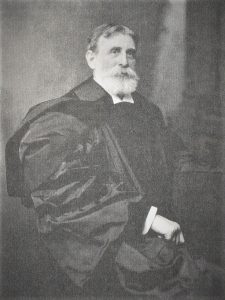 The following article is titled, “B. B. Warfield’s Reviews of His Own Writings in the Princeton Seminary Journals,” and was first published on pages 18-23 of the Fall/Winter 2022 newsletter, Reformed Forum. The text of the original and the copy below are the same except the footnotes in the original began anew with each page, but in the transcription they continue from page to page. The article draws attention to Warfield’s death a century prior in 1921 and it announced the availability of “A Table of B. B. Warfield’s Book Reviews in The Presbyterian and Reformed Review and its Predecessors” on the Reformed Forum site. Click HERE to go to the page for downloading a free copy of the more than two-hundred-fifty-page PDF table of nearly 1300 reviews. A brief biography of Warfield is available on this site HERE. There is also an archive category for him on this site available for reference HERE.
B.B. Warfield’s Reviews of His Own Writings in the Princeton Seminary Journals
Barry Waugh
If an academic journal were opened nowadays and a review of a publication written by the editor was included it would be thought inappropriate, if not vain. B. B. Warfield began reviewing his own publications and those issued with his Princeton Seminary colleagues beginning in 1890 in The Presbyterian and Reformed Review. The Princeton journals were considered sources of reliable information about publications useful to Christians in general and Presbyterians in particular. Whose books would be better to recommend than those written by Warfield and his like-minded colleagues? The growing doctrinal division within the Presbyterian Church in the United States of America would accelerate due to publicity from the heresy trial of Charles A. Briggs resulting in greater public interest in theological issues such as higher criticism, modernism, fundamentalism, and confessionalism. It was Princeton Seminary’s responsibility as a servant of the church to critique the worst and recommend the best theological literature relevant to current issues. As events came to crisis in the late nineteenth and into the twentieth century, Princeton was looked to as the seminary to defend the infallible Word with its journal providing responses to not only Charles A. Briggs, but others such as Adolf Harnack and Albrecht Ritschl. Whether the Bible-believing church was Presbyterian, Methodist, Baptist, or Fundamentalist, Princeton provided the ordnance needed to defend Scripture and its doctrines.
The fourteen reviews that follow have been determined to be Warfield’s based on his signature at their ends, because he is listed as author in a journal index, or because he was editor of the journal at the time. The word “review” includes anything from a brief notice of a sentence or two to nearly three pages. Among the authors reviewed in the seminary journals by Warfield, his own publications rank fifth.
B.B. Warfield did not only subscribe to the Westminster Standards as a Presbyterian minister but was also a historian, bibliographer, and defender of their confession and catechisms. A two-page review of nineteen titles addressing the P.C.U.S.A.’s proposed revision of the Westminster Confession of Faith was published in The Presbyterian and Reformed Review for November 1890.[1] Revision was brought to the fore when the General Assembly of 1889 sent down to the presbyteries two questions for consideration. The first question was whether the presbyteries desired revision of the Confession of Faith, and if they did, the second asked in what respect and to what extent should it be revised.[2] The next Assembly received the presbytery votes which favored moving toward revision by a nearly two to one margin.[3] A committee was appointed to bring recommendations to the Assembly scheduled for 1891. The controversy resulted in numerous newspaper and journal articles, pamphlets, and books that made cases on both sides of the issue.[4] Two of the nineteen titles included in this review were works by Warfield, one authored by him alone under the title, On the Revision of the Confession of Faith, and the other publication reprinted a press debate prompted by Henry J. Van Dyke’s response to a newspaper article about revision published by John De Witt. Fellow Princetonian Warfield and Union Seminary’s W. G. T. Shedd also entered the dispute.[5] Other books reviewed include titles by Charles A. Briggs, Philip Schaff, and Francis L. Patton, among others.[6] Warfield summarized his assessment.
Nearly all conceivable positions are taken in them; ability is shown on every side; though both the logical and theological victory belong in our judgment to those who defend the Confession, and certainly to those who defend the old theology, against which nothing is urged in these pamphlets which has not been urged with greater force, and refuted, in the Remonstrant and Arminian controversies.[7]
Note the use of “in our judgment.” This might be thought a matter of Victorian propriety but in fact the journal was published by the Princeton Seminary faculty and the views expressed were at least in theory common among the professors. The faculty as writers and editors for the journal stood together. This was all the more reason for Presbyterians to look to The Presbyterian and Reformed Review for orthodox direction. Warfield assessed the publication as a historical theologian and looked back three-hundred-fifty years to the divines assembled at Westminster as they addressed the theological influences of their day. The Westminster Standards were not composed in isolation but in the context of other theological influences such as Socinianism, Anabaptist, Roman Catholicism, and mysticism which would soon seed the quietist Quakerism of George Fox. The move to revise, said Warfield, was really a move to adopt the views James Arminius expressed in the Netherlands in the seventeenth century and dilute if not wipe away the Calvinism of the Westminster Confession.
When the 250th anniversary of the Westminster Standards occurred in 1897, Warfield accepted an opportunity to speak on their significance before the Presbytery of New York.[8] It was a particularly significant invitation given that just a few years earlier Charles A. Briggs had been convicted of eight counts of heresy by a three-to-one vote of the General Assembly as it overruled the Presbytery of New York’s decision to the contrary. Warfield was among those seeking the conviction of Briggs because his views were contrary to the Westminster Standards and because of his higher critical approach to the Bible. It must have been a collar-tugging experience for Warfield. His address was summarized in The New York Times.
The significance of the Westminster Standards as a creed is to be found in the three facts that, historically speaking, they are the final crystallization of the elements of evangelical religion, after the conflicts of 1,600 years: scientifically speaking, they are the richest and most precise and best guarded statement ever penned of all that must be safeguarded if evangelical religion is to persist in the world, and, religiously speaking, they are a notable monument of spiritual religion.[9]
He included his published speech in a single review of five items commemorating the semi-quincentennial. After starting with a positive verse tuned by a patronizing tone regarding James Moffat’s work, Warfield critiqued his contribution to one of the books:
The query may occur to the reader, indeed, whether in his assumption of a defensive rather than a positively self-congratulatory point of view, Dr. Moffat may not, in one instance, have been misled into the use of language—no doubt unwittingly—which may seem to surrender the very principle of electing grace which he is engaged in so winningly defending.[10]
But Moffat’s surrender was not unique because Warfield found the other publications feeble regarding their backing of the Standards.
If any criticism arises in the mind of the reader of them, as they lie on the printed page divorced from the voice and gesture which gave them wings to the hearer, it is that a slightly apologetical tone is perhaps too prominent in them.[11]
With the increasing movement to revise the Westminster Confession came hedged support for its teaching from some who wanted to appear faithful to their ordination vow subscribing to its teaching. Warfield’s position was not half-hearted but enthusiastic because he believed “the essence of evangelical religion” has been “clearly and purely stated in the Westminster Standards,” and they manifest “combined scientific precision and religious vitality.”[12] He did not elaborate on how they are scientifically precise, but one can picture the Assembly committees gathered for sessions searching the Scriptures and theological resources for facts much as one analyzes geological specimens noting their attributes for categorization. For Warfield, Christianity is the scientific religion based on the Bible and it necessarily follows that since the Standards are derived from Scripture, they too must be scientific. His observations concluded hoping that, despite his sense it was too late, the Presbyterian Board of Publication would collect from the many lectures delivered throughout the denomination and publish two volumes as “a fitting memorial of a great occasion.”[13] Unfortunately, Warfield’s observation of an apologetical tone among the writers might have precluded carrying the anniversary celebration (reluctant remembrance?) too far. It is indeed unfortunate that as the anniversaries of the Standards have passed, there have been fewer and fewer that cared to wholeheartedly celebrate their composition and abiding value.
The Warfields were unable to have children, but their situation did not prevent him from reviewing theological publications and subjects relevant to children and parents. In fact, his reviews of family-relevant books, catechetical tools, and children’s fiction and non-fiction show that the absence of children at home made the couple’s hearts grow fonder. Those who have suffered the loss of a child or could not have children can identify with the Warfields. One subject of pressing consequence to parents is the salvation of their unborn or infant children. In 1891 Warfield reviewed D. L. Wilson’s, Are They Lost or Saved? What do Presbyterians Believe about Those Who Die in Infancy? He said of the book that despite some exegetical weakness it was a “sound little tract,” because it lays, first, “emphasis where it ought to be laid, on the need of salvation for infants,” and secondly, “their dependence for salvation on the electing love of God.” He added that no “declaration of infant salvation can be held to be accordant with God’s Word, which does not emphasize these two necessary truths.”[14] In the review that follows the one for Wilson’s book, Warfield summed up his own sixty-page pamphlet on the subject, The Development of the Doctrine of Infant Salvation.[15] He said that the booklet describes “briefly the historical course of doctrinal thought as to the salvation of infants” and shows “that the Calvinistic theology alone offers a logical basis for teaching that all that die in infancy are saved.”[16] The “all” is an all-inclusive all; he is speaking of universal infant salvation (but he does not use the term universal). In 1897, Warfield took up infant salvation again refining his previous work in Two Studies in the History of Doctrine, which he reviewed in The Presbyterian and Reformed Review.[17] The review was primarily a response to William Rupp’s criticism of his series of articles on infant salvation published sequentially in Christian Literature from March to August 1897.[18] Rupp published his review as editor of The Reformed Church Review.[19] He briefly presented summaries of historic interpretations of infant salvation before saying that Warfield had no proof for his view of universal infant salvation other than its growing popularity among Christians. Rupp said the Bible did not support it, but more importantly, it contradicted the Westminster Confession, 10:3, “elect infants, dying in infancy, are regenerated, and saved.” For Rupp, elect is used in the sense of infants who are elect, not the sense that all infants are elect. [20] He also turned to Article 17 of the Canons of Dort referring to, “godly parents have no reason to doubt of the election and salvation of their children whom it pleaseth God to call out of this life in their infancy.” [21] Dort’s statement seems more reassuring than the Confession in that having “no reason to doubt” means certainty of salvation of all infants of “godly parents,” but like Westminster, it comes short of universal infant salvation. Rupp’s presentation looks good so far but then his review took a turn when he rejected what he described as “the odious theory of unconditional predestination,” for which he substitutes the moral theory of infant salvation that universally implies faith, free choice, and moral development.[22] How he could appeal to Dort and Westminster yet deny predestination is not developed. He said, “The dying infant, it must be assumed, will not always remain an unconscious infant, but will pass through a process of intellectual and moral development, which will be essentially the same as that which it would have passed through if it had lived to maturity in this world” and this development occurs after death “in the spirit world.”[23] Interest in an intermediate spiritual state between death and hell had recently become influential within the Church of England as well as among other individuals such as Charles A. Briggs and here it is seen in Rupp’s analysis. Warfield responded that Rupp offered at best the possibility of all infants dying in infancy being saved because his abandonment of predestination left deceased infants in a worse condition than when alive in a loving home with Christian influences.
Dr. Rupp, indeed, tentatively suggests that parents may “trust that the place of their own care and training will be supplied by the loving service of beings holier and wiser than they [are], who will not even make the mistakes which they themselves would have been likely to make,” and feels authorized on this suggestion to conclude that “the salvation of dying infants, if not more sure, is at least not less sure, than is that of the living.”[24]
Rupp’s contention that Warfield had no biblical nor confessional foundation for his view received no response other than his general appeal to Calvin and Reformed theology. It is difficult to determine exactly where Warfield stood on the issue. As Rupp interpreted him, it was for him a fact that Warfield held to infant salvation, but in all three of Warfield’s publications his position is not precise. He found the idea “probable,” in Development and “a certain or probable fact” in the subsequent two works.[25] What is curious is he did not deny Rupp’s attribution of belief in salvation for all deceased infants. It appears his view is asymptotic—he came as close to believing all infants dying in infancy were elect and thus saved without quite getting to the view. The subject is a delicate one and pastors sometimes find themselves having to counsel parents about the deaths of their infants. Warfield’s childless home may have increased sensitivity to the gravity and emotional difficulty of the subject. If he and Annie had suffered from the death of unborn children, then the subject was close to home and he would have empathized with those experiencing similar loses.
The deity of Christ has been questioned since the day when the Jews said he was a blasphemer because he called “God his Father, making himself equal with God” (John 5:18). In Warfield’s era denial of Christ’s deity was not based on jealousy for the Father’s divinity, as was the case with the Jews’ accusation against Jesus, but instead resulted from anti-supernaturalism gaining ground within Christianity. Two titles reviewed by Warfield published by the seminary community are The Lord of Glory and Is Jesus God?[26] Both books were reviewed by him in The Princeton Theological Review.[27] In his single-page notice for The Lord of Glory he summarized the purpose of his book.
What is attempted in this book is primarily a survey of the designations which the New Testament writers apply to our Lord, with a view to acquiring a sense of the attitude, intellectual and emotional, sustained by them to the Lord’s person. But a secondary purpose is intertwined with this. This is to exhibit, by this example, the clearness and strength of the testimony of the New Testament to our Lord’s essential divinity.[28]
The book not only defends the deity of Christ but does so interacting with critical views to the contrary. One such critical perspective involved the messianic self-consciousness which theorized Jesus instead of being the Messiah conformed himself to fit the Bible’s description of the Messiah. At best this made the perfect Son of God merely a confused man; at worst it made him a charlatan. Another critical perspective that developed came from the views of Albrecht Ritschl and Adolph Harnack, also manifest in the work of Albert Schweitzer, which contended that the true account of the primitive Jesus must be selectively harvested from the Gospels which are muddled accounts resulting from confusion about his identity distorted by supposed supernatural events. Critics said the Gospels were composed late in the second century and by then too much water had gone under the bridge for the writers to have any chance of getting their facts right.[29] Warfield makes it clear with his detailed account of the names and designations of Jesus that not only was the Lord self-consciously aware of his deity, so were those who walked with him and wrote about him. The great list of designations referring to Jesus are decidedly supernatural describing the Son of God. The overwhelming evidence to Jesus’ deity could not be denied. A few years later Is Jesus God? was published in celebration of Princeton Seminary’s centennial.[30] The book provides the nine best essays composed by Princeton seminarians for class work to answer six questions in defense of the divine Christ. Warfield’s review sets out a summary of the book for which he wrote the introduction. He notes that it is “a specimen of the kind of work done in the classrooms of the Seminary, and it is hoped that in their published form they may prove useful.”[31] What better way is there to affirm the effectiveness of a Princeton Seminary education than the orthodox papers of students defending doctrine? The deity of Christ is an essential fact drawn out historically by the ecumenical councils and believed for centuries, but in Warfield’s day it faced increased skepticism as higher criticism created a de-divinitized Bible yielding a de-divinitized Christ.
Warfield’s The Right of Systematic Theology, 1897, is the reprint of an article bearing the same title published in The Presbyterian and Reformed Review.[32] The reprint was issued in an attractive burgundy binding with gold leaf lettering which surely appealed to Warfield the bibliophile’s aesthetic sense. The reason for publication in Scotland as expressed in the “Note of Commendation” prefacing the book was to make available his defense “of that science” of theology which “appeared to us well worthy of a wider circulation in this country than it can hope to have in a journal published in America.” Included among the twelve theologians commending “to the attention of all who have in any degree realized the importance of the subject” are W. G. Blaikie, A. H. Charteris, and John Laidlaw.[33] Warfield’s entire review is as follows:
The readers of this Review are entitled to share the gratification which its author feels in the republication in Scotland of this paper from the pages of the Review, at the call of a number of leading theologians, and with a kind and interesting Preface by Prof. Orr. They will doubtless join with the author in returning thanks to the gentlemen who have taken the responsibility in the matter, and in expressing appreciation of the pleasant words they have spoken and the hope that the little book will prove sufficiently useful to justify their action.[34]
James Orr and company’s graciousness were appreciated, but Warfield was not always in agreement with the theologians from Scotland. Blaikie had defended the vindication of Marcus Dods and A. B. Bruce by the Free Church of Scotland General Assembly in 1890 regarding their views of inspiration, and he was criticized for it by Warfield.[35] He said of Laidlaw’s Foundation Truths of Scripture as to Sin and Salvation that the “whole objective side of salvation might, indeed, be wisely strengthened in the second edition of this excellent little volume.”[36] He would come to be critical of Orr’s lectures delivered at Western Seminary objecting to his views of the formation of the Canon, Augustine’s understanding of regeneration and predestination, and “the Kenotic corollary of the limitation of Christ’s earthly knowledge.”[37] And with respect to Charteris, he would assess The Church of Christ, 1905, as “Harnackian” and say that the author minimized “the value of sound doctrine in the Church,” but then he would kindly conclude his review saying, “May the blessing of God attend Dr. Charteris’ message to His Church and give it effect upon us all.”[38] Warfield had praised the practical aspects of the book, so his intention in calling for God’s blessing must have been with reference to that aspect. Regardless of differences, the generosity of the Scots made Warfield’s work more readily available in Great Britain and showed that even criticism does not necessarily exclude graciousness. It is sometimes difficult to determine in his reviews how much of what he said was sincere and how much was tongue-in-cheek or patronizing, but in this case, his gratefulness appears genuine.
Warfield used one of his reviews to defend himself. The title is a volume in the Temple Bible Series which provides the text of Acts, the Pastoral Epistles, and Philemon.[39] J. M. Dent & Company had made its name publishing classics and would go on to publish other series. The Temple Bible Series provided pocket-size portions of Scripture with introductions and other information in appendices. Bindings are leather with gold lettering and gilt-edge text blocks. Included in each book is a quality reproduction of a relevant work of art for its frontispiece. The text is printed in black with red ink phrases setting-off sections and accenting the book in other ways. The series is an aesthetically pleasing one which would have appealed to Warfield’s love of fine books. The series had an introduction volume by Bishop of London William Boyd Carpenter, and an assortment of writers edited the other books which totaled about thirty. Warfield’s single-paragraph review of his book clarifies what he contributed to the finished product.
This is one volume of the “Temple Bible” which, under the editorial care of Mr. Oliphant Smeaton, is published by J. M. Dent & Co. in the dainty form for which that house has grown famous. The present writer is responsible only for the “Introduction” (pp. i-xlviii); in it he has tried to set forth in a form suitable to the English reader the salient literary facts concerning the Acts, the Pastoral Epistles, and the Epistle to Philemon. He did, indeed, prepare also the very brief series of “Notes” (pp. 123-130); but by some accident he missed seeing the proofs of this portion of his work and he would not like to be held responsible for the form in which they appear. For the rest of the volume, he has no responsibility whatever, and he thinks it worthwhile to emphasize this, inasmuch as in the “Synchronism of Ancient History” (given on pp. 132-139), a scheme for dating the New Testament books is set down which runs athwart the dates suggested in the “Introduction.” He cannot help accounting it an infelicity that the title-page bears only his name as “Editor,” whereas he is in no sense the “Editor” of the volume and is responsible for only a portion of its contents.[40]
Once one gets past the Kentucky born breeder of short-horn cattle using the word “dainty,” it is clear he was upset about being designated editor and troubled by the dating of the New Testament books. But what is it about the “Notes” that he found objectionable as to “the form in which they appear?” An answer can only be surmised, and it is not theological but utilitarian. The biblical text in the book does not use chapter and verse numbers. Instead, the beginning of each chapter as taken from the Authorized Version (King James) is noted with an asterisk and line numbers in the margin of each page have replaced versification (like in a legal or congressional document). There is no indication in the biblical text that there is a note regarding a passage; one must read the notes and then reference back by means of page and line numbers. For example, one comment in the notes on page 124 says that the portion of text on page 29, lines 22-26, beginning with “it is hard” and ending with “And the Lord said unto him,” should be omitted. The passage is Acts 9:5b-6a. This is one of seven textual omissions in Acts noted by Warfield. No reasons are given for the omissions (at least none were published), but it is probable they are based on analysis of original language biblical manuscripts in addition to the Textus Receptus used for the King James for a more accurate translation. The system for notes is cumbersome at best and simply inept at worst. If Warfield wrote his notes in the traditional footnote form in his manuscript, then when the editor modified them for publication he could have confused or inadvertently removed important material. Warfield liked the small, quality form of the book, but he was not pleased with how his material was handled. This is a case for Warfield of not being able to judge a book by its cover.
One particularly important title reviewed by Warfield which included an essay by him was Biblical and Theological Studies, 1912, which celebrated the Princeton Seminary centennial. Warfield’s contribution, “On the Emotional Life of Our Lord,” is described in his review as “an attempt to ascertain with some exactness the precise emotions which are expressly assigned to our Lord in the Evangelical narrative, that a firm basis may be laid for a study of our Lord’s emotional life.”[41] He looked at several words such as compassion to bring out the emotional aspect of the Lord. Francis L. Patton wrote on theological encyclopedia; John D. Davis focused on Christ; a study of Jonathan Edwards was given by John DeWitt; William B. Greene, Jr. emphasized the supernatural; Geerhardus Vos studied the eschatological aspect of Paul’s conception of the Spirit; the Aramaic of Daniel interested linguist Robert D. Wilson; William P. Armstrong summarized the resurrection appearances of Jesus; Charles R. Erdman was concerned about modern spiritual movements; homiletics was F. W. Loetscher’s subject; James O. Boyd addressed sin and grace parallels in the Koran (would not likely go over well post 9-11); the finality of the Christian religion was C. W. Hodge, Jr.’s topic; Kerr D. Macmillan wrote about the Shepherd of Hermas; Jesus and Paul was J. Gresham Machen’s focus; and O. T. Allis offered thoughts on the transcendence of God. The review concludes with Warfield’s bibliophilic assessment that the book is “clearly printed and handsomely bound.”[42] The review is simply an advertisement for Biblical and Theological Studies.
Four of the Warfield self-reviewed titles are collections of sermons or lectures he delivered on the Princeton campus. The longest review is a few paragraphs about The Power of God unto Salvation, 1903, which is an assortment of eight chapel sermons.[43] In the context of skepticism about the divinity of Christ and the nature of salvation in his era, “A certain unity is given to the volume by the fact that all the sermons treat of the divine element in the process of salvation, as is, indeed, intended to be indicated by the title.”[44] Warfield’s The Savior of the World was released a decade later with nine sermons stressing Jesus Christ as the Savior of not only individuals but of the world.[45] The first sermon “endeavors to make plain the universal need of salvation; the second the sole provision of Salvation in Christ; the third the world-wide reach of His salvation; while the subsequent ones seek to enforce this main message and to bring out particular elements in our Lord’s saving work.”[46] Then in 1915 the book that became a classic, The Plan of Salvation, was published containing five lectures delivered during the Princeton Summer School of Theology. It was dedicated to Emeritus Professor of Church History John De Witt whom Warfield described as a “Lover of Letters, Lover of Men, Lover of God.”[47] The first lesson set the pattern for the remaining four.
The differing conceptions are passed in rapid review, in ascending order. First the fundamental opposition of Naturalism and Supernaturalism is pointed out; then the division among the Supernaturalists between Sacerdotalists and Evangelicals is indicated; next the Universalistic and Particularistic varieties of Evangelicals are distinguished; and lastly the several kinds of Particularists are intimated. The outcome is to fix on Infralapsarian Calvinism as the only tenable conception. This lecture is accompanied with a tabular arrangement of the several views which is supposed to facilitate their understanding.[48]
Warfield’s scientific method comes through again as he differentiates naturalism and supernaturalism and their sub-categories as if he were breaking down the classifications of fauna or flora. As these personal reviews tend to do, this one is simply a summary of the content which could be used on the dustjacket of a modern reprint to entice shoppers to purchase a copy. The final book reviewed is Faith and Life, published in 1916.[49] When his close friend and colleague George T. Purves passed away in 1902, Warfield and some seminary colleagues edited a book in his honor bearing the same title.[50] Warfield dedicated his own Faith and Life to his brother Ethelbert describing him as “A Brother Beloved in the Flesh and in the Lord.” The book was published just a matter of months after the passing of his wife Annie. Her death appears to have turned him to remember his brother as he recognized the frailty of earthly life and two brothers in the Lord, Purves and Ethelbert. It is speculative, but the death of those near and dear tends to focus one’s thoughts more on being absent from the body, and it seems sentimentality may have contributed to titling the book Faith and Life. Included are forty-one discourses delivered Sunday afternoons, which “are in the main expository in intention” with the passages randomly selected but intended for men preparing for the ministry with Warfield’s hope that the lessons “may prove useful in wider circles than those to which they were first spoken.”[51] Consistent with Warfield’s staying close to home to care for his wife, these four collections of sermons, discourses, and lectures were first delivered within the Princeton community.
Conclusion
As the years have passed academic journals have tended to limit their subject matter to publications specifically related to their areas of expertise, but it is clear from reading more than 1200 reviews by B. B. Warfield in the Princeton journals that just about anything was fair game even reviews of his own works. As the years passed, the journal became more specialized with less editorial authority given to any one faculty member. The journal titles during Warfield’s tenure at Princeton were The Presbyterian Review (1880–1889), The Presbyterian and Reformed Review (1890–1902), and The Princeton Theological Review (1903–1929)—Warfield died in 1921. His greatest influence was during TP&RR years as editor with his articles and reviews dominating some of the quarterly issues. In some issues there were more pages dedicated to reviews than articles, but reviews always had a substantial portion of the text. Warfield’s self-reviews provide a perspective on how Princeton used its journals. First, reviews could not only be serious criticism interacting with books but also simply provide information summarizing content and perspective. The seminary faculty functioned under the oversight of its denomination and was not only an institution for training ministers but also a source of information about books for church members. If a church Bible teacher wanted a good book on justification, prayer, or the Reformation, it was the obligation of the Princeton journals to give guidance. In Warfield’s day, it was common for not only seminary and religiously based colleges to subscribe to the Princeton journal, but also local public universities, community libraries, and even state libraries (surprising, isn’t it). Second, as has been seen regarding Warfield, reviews were used for defense and setting the record straight. When he thought he was assessed incorrectly by Rupp and misrepresented by The Temple Bible series, he used his reviews to clarify and defend his positions. Third, the seminary’s journal was used to promote the seminary as seen in Warfield’s reviews of the student publication Is Jesus God? and the faculty collection Biblical and Theological Studies. Fourth, as is the case with Warfield’s reviews of his titles on Christology, reviews confronted the errant directions taken by contemporary theology. Christ’s deity and authenticity as the Messiah were denied by some, so his writings addressed these subjects, and his reviews of his own writings presented them to the public. Finally, failure to read reviews written by authors eliminates a valuable source of information that might not be available in their monographs, essays, sermons, or articles.
Notes
[1] The Presbyterian and Reformed Review (TP&RR, 1890), 1:4, 698.
[2] Minutes of the General Assembly of the Presbyterian Church in the United States of America with an Appendix, New Series, Vol. 13 (Philadelphia: McCalla, 1890), 122.
[3] The count of the presbyteries was as follows: 4 failed to vote; 7 declined to do so; 134 were for the overture, and 68 were against it.
[4] Minutes of the General Assembly of the Presbyterian Church in the United States of America with an Appendix, New Series, Vol. 13 (Philadelphia: McCalla, 1890), 127.
[5] John DeWitt, Henry J. Van Dyke, W. G. T. Shedd, and B. B. Warfield, Ought the Confession of Faith to be Revised? A Series of Papers (New York: Anson D. F. Randolph, 1890).
[6] Charles A. Briggs, et al, How Shall we Revise the Westminster Confession of Faith? A Bundle of Papers (New York: Charles Scribner’s Sons, 1890); Philip Schaff, Creed Revision in the Presbyterian Churches (New York: Charles Scribner’s Sons, 1890); and Francis L. Patton, The Revision of the Confession of Faith Read before the Presbyterian Social Union, New York, December 2, 1889 (New York: K. Van Rensselaer, 1889).
[7] TP&RR, 1890, 1:4, 699.
[8] B. B. Warfield, The Significance of the Westminster Standards as a Creed. An Address delivered before the Presbytery of New York, November 8, 1897, on the Occasion of the Celebration of the Two Hundred and Fiftieth Anniversary of the Completion of the Westminster Standards (New York: Charles Scribner’s Sons, 1898).
[9] “N. Y. Presbytery Meets: The Members Celebrate the 250th Anniversary of the Adoption of the Westminster Standards,” The New York Times, Tuesday, November 9, 1897, 4; it is not clear if the reporter wrote this as his summary or if it was excerpted from Warfield.
[10] James Moffatt, “Fundamental Doctrines of the Westminster Confession and Catechisms,” in William H. Roberts, ed., Addresses at the Celebration of the Two Hundred and Fiftieth Anniversary of the Westminster Assembly by the General Assembly of the Presbyterian Church in the U. S. A. (Philadelphia: Presbyterian Board of Publication, 1898), 109-27; TP&RR, 1899, 10:39, 561.
[11] TP&RR, 1899, 10:39, 561.
[12] B. B. Warfield, The Significance of the Westminster Standards as a Creed. An Address delivered before the Presbytery of New York, November 8, 1897, on the Occasion of the Celebration of the Two Hundred and Fiftieth Anniversary of the Completion of the Westminster Standards (New York: Charles Scribner’s Sons, 1898).
[13] TP&RR, 1899, 10:39, 562; the author could find no evidence of such a publication being issued.
[14] TP&RR, 1891, 2:7, 534; a copy of Wilson’s pamphlet could not be located.
[15] TP&RR, 1891, 2:7, 534; B. B. Warfield, The Development of the Doctrine of Infant Salvation (New York: The Christian Literature Co., 1891).
[16] TP&RR, 1891, 2:7, 534; the series ran as the lead article in monthly installments from March to August 1897, in Christian Literature 16:5 to 17:4, issue 1 of vol. 16 was published Nov. 1896 and issue 1 of vol. 17 May 1897.
[17] B. B. Warfield, Two Studies in the History of Doctrine. Augustine and the Pelagian Controversy: The Development of the Doctrine of Infant Salvation (New York: The Christian Literature Co., 1897); TP&RR, 1898, 9:33, 176.
[18] TP&RR, 1898, 9:33, 176; The chronology is: Warfield published The Development of the Doctrine of Infant Salvation, then the series of articles in Christian Literature was published, Rupp reviewed them, Warfield published the section on infant salvation for Two Studies in the History of Doctrine, and then he reviewed his book interacting with Rupp’s critique.
[19] William Rupp, ed., “Infant Salvation,” The Reformed Church Review 1 (Jan. 1897), 521-30.
[20] Rupp, “Infant Salvation,” 526.
[21] TP&RR, 1891, 2:7, 534; B. B. Warfield, Two Studies in the History of Doctrine. Augustine and the Pelagian Controversy: The Development of the Doctrine of Infant Salvation (New York: The Christian Literature Co., 1897).
[22] Rupp, “Infant Salvation,” 528.
[23] Rupp, “Infant Salvation,” 529.
[24] Rupp, “Infant Salvation,” 529.
[25] Warfield, Development, 37-38, uses “probable”; and the last two use “to be a certain or probable fact,” Christian Literature 17:4 (Aug. 1897), 275, and Two Studies, 239.
[26] B. B. Warfield, The Lord of Glory. A Study of the Designations of our Lord in the New Testament, with Especial Reference to His Deity (New York: American Tract Society, 1907); B. B. Warfield, intro., Is Jesus God? An Argument by Graduates of Princeton Seminary. With Introductory Note by Prof. B. B. Warfield, D.D. (New York: American Tract Society, 1912).
[27] The Princeton Theological Review (TPTR), 1908, 6:1, 127
[28] TPTR, 1908, 6:1, 127.
[29] Those who hold to the historicity of the Gospels including their supernatural events would say all the gospels were complete by 70 A.D. and many would date them at least a decade earlier.
[30] R. B. Kuiper, D. S. B. Joubert, H. H. Meeter, Johannes D. Roos, Frank M. Richardson, William A. Motter, William Nichol, Gerrit Hoeksema, and Luther M. Bicknell.
[31] TPTR, 1913, 11:2, 338.
[32] Benjamin B. Warfield, intr. James Orr, The Right of Systematic Theology (Edinburgh: T. & T. Clark, 1897); “The Right of Systematic Theology,” TP&RR 27 (July 1896), 412-58; the previous issue of TP&RR included an article titled, “The Idea of Systematic Theology,” pages 243-71.
[33] Benjamin B. Warfield, intr. James Orr, The Right of Systematic Theology (Edinburgh: T. & T. Clark, 1897), 5.
[34] TP&RR, 1897, 8:30, 360.
[35] TP&RR, 1891, 2:6, 348.
[36] John Laidlaw, eds. Marcus Dods and Alexander Whyte, Foundation Truths of Scripture as to Sin and Salvation in Twelve Lessons (Edinburgh: T. & T. Clark, 1897); TP&RR, 1897, 8:32, 823.
[37] TP&RR, 1902, 13:51, 486; James Orr, The Progress of Dogma, being the Elliot Lectures, delivered at the Western Theological Seminary, Allegheny, Penna., U.S.A. (New York: A. C. Armstrong & Son, 1902).
[38] A. H. Charteris, The Church of Christ, Its Life and Work. An attempt to trace the work of the Church in some of its departments from the earliest times to the present day (London: Macmillan, 1905); TPTR, 1907, 5:1, 147.
[39] B. B. Warfield, ed. Acts & Pastoral Epistles Timothy-Titus & Philemon, series The Temple Bible (London: J. M. Dent & Co., New York: J. B. Lippincott Col, 1902).
[40] TPTR, 1904, 2:1, 157.
[41] TPTR, 1912, 10:3, 465; Biblical and Theological Studies, by the Members of the Faculty of Princeton Theological Seminary. Published in Commemoration of the One Hundredth Anniversary of the Seminary (New York: Charles Scribner’s Sons, 1912).
[42] TPTR, 1912, 10:3, 467.
[43] Benjamin B. Warfield, The Power of God unto Salvation (Philadelphia: Presbyterian Board of Publication, 1903).
[44] TPTR, 1903, 1:4, 683,
[45] Benjamin B. Warfield, The Savior of the World: Sermons Preached in the Chapel of Princeton Theological Seminary (New York: Hodder and Stoughton, 1913).
[46] TPTR, 1914, 12:4, 695.
[47] Benjamin B. Warfield, The Plan of Salvation: Five Lectures delivered at the Princeton Summer School of Theology, June 1914 (Philadelphia: Presbyterian Board of Publication, 1915).
[48] TPTR, 1915, 13:3, 496.
[49] Benjamin B. Warfield, Faith and Life; Conferences in the Oratory of Princeton Seminary (New York: Longmans, Green, and Co., 1916).
[50] George T. Purves, ed. B. B. Warfield, E. R. Craven, John De Witt, and W. P. Armstrong, Faith and Life: Sermons (Philadelphia: Presbyterian Board of Publication, 1902).
[51] TPTR, 1916, 14:4, 677.