
 bwaugh
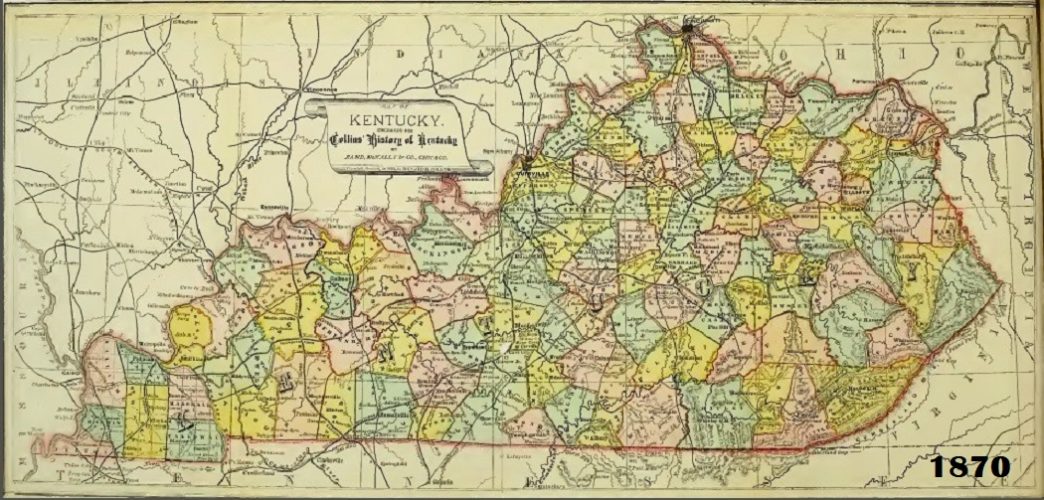
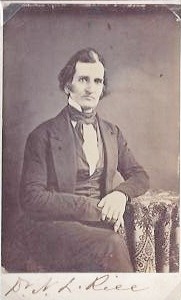 Nathan Lewis was born December 29, 1807 in Garrard County, Kentucky to Gabriel and Phebe (Garrett) Rice. The family lived on a farm where the household struggled to make ends meet as did many rural families. Nathan began teaching school when he was sixteen years old to raise money for college tuition. At first, he wanted to become a lawyer but plans changed shortly after he became a Christian at the age of eighteen in Harmony Presbyterian Church. Despite the struggle he was having raising funds for an education, he refused assistance from his brothers and persevered making his own way. He chose Centre College in Danville, Kentucky and matriculated in the fall of 1824. The college president was a frontiersman minister named Gideon Blackburn who was a colorful character. His ministry included several years in remote areas of eastern Tennessee where he often preached with a musket by his pulpit. Rice was a diligent student whose proficiency in Latin earned him the opportunity to teach the language for income while he completed college studies.
Continuing to live in Danville after graduating Centre, N. L. Rice studied theology for about a year with Gideon Blackburn. In order to test his ministerial skills he was licensed to preach by Transylvania Presbytery October 4, 1828. The following January he was called to pastor his home congregation but declined because he wanted to study theology further, so he headed east to New Jersey and began classes in Princeton Seminary the fall of 1829. His class numbered forty-one students including his brother, John Jay Rice, and two southerners who would teach in Columbia Theological Seminary, John Bailey Adger and Charles C. Jones. During his Princeton residency on October 3, 1832 he married Catherine, who was the eldest daughter of the Rev. James K. Burch.
With certificate of completion from Princeton Seminary in hand, Rice returned to Kentucky to pastor the church in Bardstown. He was ordained and installed June 8, 1833. As was so often the case with ministers in frontier and rural areas, the locals looked to Rice to provide schooling for their children. An academy for girls and another for boys were established adding school master to his ministerial duties. The news media of the day was the local newspaper and Rice added publishing to his work by establishing a venue for religious news called The Western Protestant, which eventually merged with another paper to become The Presbyterian Herald of Louisville. He served in Bardstown until the pastoral relation was dissolved April 8, 1841. Pastor Rice was dismissed to the Presbytery of Ebenezer where his call included work as a home missionary and the stated supply for the church in Paris, Kentucky.
As his ministry developed, Rice increasingly participated in controversy regarding doctrine. During his years in Paris he debated Alexander Campbell in 1843 on the subjects of baptism, sanctification, and the use of creeds. Campbell’s ideas on the subjects were contrary to the New Testament and he believed further that the simple gospel had been corrupted by the denominational structures and bureaucracy of Presbyterianism. The growth of Campbell’s influence in Kentucky and his argumentation against doctrine prompted Rice to defend the Bible’s teaching as expressed in the Westminster Standards and the venue for defense would be debate.
It may be difficult in the twenty-first century given the abundance of visual media to understand the appeal of public speakers in ages past whether it was from pulpits, podiums, or stumps. Churches were often attended not only by Christians gathering for worship but also individuals seeking Sunday morning entertainment. Such visitors wanted to hear whether the preacher would deliver a rhetorical masterpiece or stumble along miserably. Others would wander in, sit in the back pew or balcony and laugh at or bait the minister. Deacons were assigned to act as bouncers removing the drunk and disorderly. Great crowds would assemble to hear public religious debates and listen at church windows during presbytery meetings. Listeners expected to be charmed by oratorical finesse; hear knock-down-drag-out arguing; have some laughs as the speakers became tongue tied; and in the extreme they participated by throwing debris at speakers. Just because the speakers were ministers did not exclude them from insults by those who became restless or indignant.
Planning for the Rice-Alexander debate was considerable. It took place in Lexington. The convener was Kentucky’s Kentuckian, U.S. Senator, Congressman, and soon to be Whig Party candidate for the White House, Henry Clay. Each debater selected a moderator in the spirit of fairness with each moderator having turns directing the event. Rice’s choice for moderator was former U.S. Congressman and Chief Justice of Kentucky George Robertson, while Campbell’s man was former U.S. Congressman and standing Kentucky Congressman John Speed Smith. Each day of the debate followed a schedule agreed upon by the debaters, Monday through Saturday, no Sabbath sessions. Rice and Campbell were to exchange comments for four hours beginning at ten in the morning. There were also evening meetings. Changes to the format and scheduling were made only when agreed upon by the debaters. The eighteen days of debates were reported by the local press and even earned a brief piece in the New York Daily Tribune, November 27, 1843. In Ohio The Democratic Standard of Brown County reported on November 28 that, “Lexington is thronged at this time with spectators anxious to hear the debate.” By December 8, the Carroll Free Press of Carrollton, Ohio, informed readers that two of the propositions for debate had been completed and “the interest which” the discussion “first awakened is not at all diminished. … Large crowds are daily in attendance.” When the preliminaries of the debate were held in the Reformed Church in Lexington the audience was said to be about two thousand. However, the press reported that the next meetings were in the Main Street Christian Church which recently completed a new building with seating sufficient for its congregation, the largest in the city. It was surely a very different world for a regional debate on theology to capture the attention of listeners in other parts of the nation.
The debates were published with both Rice and Campbell editing the transcriptions and certifying their authenticity. The book was released in 1844 bearing the lengthy title,
A Debate between Rev. A. Campbell and Rev. N. L. Rice on the Action, Subject, Design and Administrator of Christian Baptism, also, on the Character or Spiritual Influence in Conversion and Sanctification and on the Expediency and Tendency of Ecclesiastical Creeds, as terms of Union and Communion: Held in Lexington, Ky., from the Fifteenth of November to the Second of December, 1843, a Period of Eighteen Days. Reported by Marcus T. C. Gould, Stenographer, assisted By A. Euclid Drapier, Stenographer, and Amanuensis.
The long title may have been composed to correspond with the book’s 912 pages of small-font, narrow-margin text. Reviewers in Princeton Seminary’s Biblical Repertory and Princeton Review, after a brief introduction to the context of the face off listed six points of discussion. The first, baptism by immersion with the Trinitarian pronouncement is the only baptism; second, the infant of a believing parent is a scriptural subject for baptism; third, Christian baptism is for the remission of past sins; fourth, baptism is to be administered only by an ordained bishop or presbyter; fifth, in conversion and sanctification the Spirit of God operates on persons only through the Word of Truth [This denies the internal work of the Spirit working with the Word in the application of redemption and growth in grace; it teaches instead that the Spirit works externally as the Word of Truth is heard and read convincing the sinner to turn from sin. Campbell appeals particularly to James 1:18.]; and sixth, human creeds as bonds of union are necessarily heretical and schismatic. Rice affirmed the second and fourth points while Campbell affirmed the remaining four. The review selects from the book excerpts by both men concerning translation of the New Testament Greek words bapto and baptizo. Campbell argued that the Greek must only and always be translated “immerse” and those through history that had not been immersed were in fact not baptized, to which Rice responded that baptizo and bapto must be translated according to context with meanings that include, “wash,” “pour,” “purify,” “sprinkle,” and “dip.” The review concluded that Rice’s response to Campbell was “so complete a refutation of the arguments usually adduced in favor of immersion as the only mode of baptism, we cannot find a single position taken by Mr. Campbell which is not here completely wrested from him” (p. 593). Archibald Alexander and John Matthews are believed to be the reviewers. It does not appear that Alexander Campbell responded to Princeton Seminary’s analysis.
While N. L. Rice was across the Ohio River in Cincinnati overseeing the publication of the debates, he was offered a call to pastor the city’s Central Church. Accepting the opportunity, Rice returned home where he and Catherine gathered the family and its possessions to move to Ohio. He was installed in Central Church January 12, 1845. During his ministry the congregation grew and became better established in the doctrines of the gospel. In addition to his pulpit and pastoral duties, he wrote several volumes, held more public debates, and taught classes for candidates preparing for the ministry. He also edited The Presbyterian of the West. After a fruitful ministry of eight years he would once again relocate the family for a new call.
Early in 1853, Rice moved due west over three-hundred miles to accept a call to the Second Presbyterian Church of St. Louis. He had been released from his pastoral charge in Cincinnati, April 9, 1853, and was installed in St. Louis on October 9. His pastorate in St. Louis was characterized by the same varied, incessant, and successful labors as his work in Cincinnati. In addition to work as a pastor and churchman, he edited The St. Louis Presbyterian and published several more books.
The next move was to Chicago which was a growing city as railroad service made it the northern hub of the Midwest. Rice became pastor the Old School congregation at the North Church when he was installed by the Presbytery of Chicago, October 20, 1858. He found the congregation small and weak but with abundant opportunities for ministry. Despite the work ahead of him with his congregation, he once again took up editing with The Presbyterian Expositor. When the General Assembly of the Presbyterian Church in the United States of America, Old School, convened in Indianapolis May 19, 1859, one of its debated decisions regarded relocating the Theological Seminary of the Northwest. The seminary had already moved from its Hanover College campus to another campus in New Albany, Indiana, because of shortages of funds, few students, and limited facilities, so it was hoped that the next site would be the last. It was Rice who suggested Chicago for the new campus. Other sites were also proposed but when the vote was taken, Chicago won by a margin of over three to one. Later in the assembly, Dr. Rice was elected the professor of didactic and polemic theology. In the fall, his professorship would be named by the seminary board for Cyrus McCormick in honor of his “Christian munificence” shown by the one-hundred-thousand dollar endowment given he gave to fund four professorships. Rice’s responsibilities had been greatly increased because he would continue as pastor of the North Church, a periodical editor, and now a teacher in the seminary.
Following a few years in Chicago, the Rices moved to New York. His new charge was Fifth Avenue Presbyterian Church which had recently suffered the death of its beloved pastor, J. W. Alexander. The nearly seven-hundred-member congregation was only surpassed in size in the Synod of New York by Gardiner Spring’s Brick Church. Pastoral calls had already been turned down by Massachusetts-born W. G. T. Shedd and pastor of First Church, New Orleans, B. M. Palmer. A few weeks after Confederate forces fired on Union troops in Fort Sumter, Kentuckian Rice was installed on April 26, 1861. During the call in New York, Dr. Rice not only had to deal with the war between North and South, but he and Catherine had to experience cultural adjustment as they transitioned from Midwest living to life in Manhattan. Elder Henry W. Jessup, who authored the centennial celebration book for the church, said of the challenges of Rice’s situation, “As a Southerner preaching in a New York pulpit during the Civil War, he occupied a very delicate position.” However, Jessup added that “by a discreet avoidance of all political topics, he maintained the affection and esteem of his people.”
Despite the positive review of Rice’s years by Jessup, the new call to the large urban congregation taxed the Kentuckian’s health resulting in exhaustion from a busy schedule. After six years, N. L. Rice, following the suggestion of his physician, was released from the call so he could move to a farm in New Jersey to convalesce. Despite the rural setting, his condition continued to weaken. In the winter of 1868, the Rices moved back to St. Louis where he could be treated by his son in law, Dr. E. S. Lemoine.
Renewed physically, N. L. Rice was offered the presidency of Westminster College which was a Presbyterian institution in Fulton, Missouri. He initially declined the offer but when pressed to acquiesce by the college board he accepted the position and began duties in the fall of 1868. The school had opened in 1851 and as with so many religious colleges, Westminster was having financial difficulties. Rice was seen to be a prominent father of the church who could strengthen the monetary situation and build an endowment while improving academics. The Synod of Missouri at its 1868 meeting expressed its concern that Westminster prepare college students for the ministry.
We are fully satisfied that our theological students should be trained, as far as possible, here on the field where they are to engage in labor. They will thus be kept in full sympathy with us and be the better acquainted with the character of the work they will be called to perform (p. 185).
This statement sounds like it would fit in with current thinking as seminaries, satellite campuses, and local ministers tailor candidates for local work—there is nothing new under the sun. The report to synod continued with its expression of hope for the leadership of Rice.
We believe that young men, expecting to become ambassadors of the Lord Jesus Christ, should receive some portion of their training from those who are actually engaged in the great work of the ministry.
The art of expounding God’s word with simplicity, and the peculiar tact that is required in pastoral visitations, can much more readily be acquired from successful pastors than from theological professors who have for years been withdrawn from the practical work of the ministry.
Note that last line which reads like it was written today with its emphasis on the importance of professors experienced in the “practical work of ministry” for teaching ministerial candidates. The importance of theological education and ministerial service were emphasized by Rice in his first address as college president when he delivered it before the Synod of Missouri with the title, “What Constitutes a Call to the Ministry?”
Westminster College’s financial situation continued to be troublesome during Rice’s years. By 1873, the faculty were complaining because they had not been paid for a year and they were fearful that rumors of reducing their number or closing the college were true. The financial problems when Rice took office were severe, but despite the need to tighten purse strings he hired additional faculty including one of his sons, John Jay Rice. Rice offered to have his own salary cut by twenty percent and then an additional ten percent if things did not improve the next year. The finances did not get better, so both salary reduction offers were taken. He decided to leave the college resigning in a letter to the board, June 17, 1874. One of several factors working against Westminster College noted by Rice was competition for students from the Missouri state institutions “which possess the great attraction of educating free of all charge” and he added that every “denominational institution in the state is suffering from this cause” (p. 226).
The next move of the household was to the village of his alma mater in Danville, Kentucky. He had been elected on June 17, 1874, to teach didactic and polemic theology in Danville Seminary. He accepted the position and was formally installed October 16, 1874, during the sessions of the Synod of Kentucky at Shelbyville. However, his time teaching seminary would be short. After the close of the session in May 1877, Dr. Rice travelled with his family to visit his brother-in-law in Bracken County. While there he grew seriously ill and passed away, June 11, 1877. His remains were taken to Fulton, Missouri for burial. He was survived by Catherine and six of their seven children.
Dr. Rice was honored for his pastoral, educational, and connectional ministry given during nearly seventy years of life. In 1855 he was chosen moderator of the Old School General Assembly for the sessions held in Nashville, Tennessee. He was given the Doctor of Divinity by Jefferson College of Canonsburg, Pennsylvania in 1844, possibly as a result of his notoriety from the press coverage of his debates with Campbell and their publication. He also served on the Princeton Seminary Board of Directors, 1861-1869.
N. L. Rice not only edited the periodicals mentioned previously but also authored several books, lectures, and sermons, a few of which will be mentioned. The lengthy debates between Rice and Alexander Campbell are a challenging read, so if one wants to know Rice’s views apart from his interaction with Campbell it would be better to read Baptism: The Design, Mode, and Subjects, St. Louis: Keith & Woods, 1855. Another topic of his day was social dancing which he addressed in A Discourse on Dancing, delivered in the Central Presbyterian Church, Cincinnati, 1847; dancing was considered inappropriate for Christians because it was thought to lead to lust and sin. The list of works on the Sabbath in nineteenth-century Christianity had a contribution from Rice titled, The Christian Sabbath: Its History, Authority, Duties, Benefits, and Civil Relations, 1863. One subject Rice addressed stepped a bit out of the ordinary, but it does address an issue of his era, Phrenology Examined, and Shown to be Inconsistent with the Principles of Physiology, Mental and Moral Science, and the Doctrines of Christianity. Also, an Examination of the Claims of Mesmerism, New York, Robert Carter & Brothers, 1849. Another theological work by Rice is his book, God Sovereign and Man Free: or The Doctrine of Divine Foreordination and Man’s Free Agency, Cincinnati: John D. Thorpe, 1851. Rice also published A Debate on the Doctrine of Universal Salvation: Held in Cincinnati…Between Rev. E. M. Pingree and Rev. N. L. Rice, D.D….[etc.], Cincinnati: J. A. James, 1845. These and other publications can be accessed for download at Log College Press.
Barry Waugh
Sources Information on Rice and Westminster College is from, History of Westminster College, 1851-1903, from 1851-1887, by M. M. Fisher, and then continued to 1903 by John J. Rice (N. L. Rice’s son), Columbia: E. W. Stephens, 1906. More can be learned about John Jay Rice from his obituary in The New York Times, December 16, 1920. The Fifth Avenue Church book is, History of the Fifth Avenue Presbyterian Church, of New York City, New York, from 1808-1908, by Henry W. Jessup, 1909, which includes information about the centennial celebration, December 18-23, 1908. The CDV of Rice seated with his signature is the author’s. For those interested in some of the difficulties faced by McCormick funding the four professorships in the seminary and particularly a conflict with Willis Lord, see, Important Correspondence, Concerning the Presbyterian Theological Seminary of the North-West…etc., New York: A. C. Rogers, 1869, 94 pages. McCormick did not want Lord in the McCormick chair and neither man cared much for the other. N. L. Rice sided with McCormick.