
 bwaugh
Drury Lacy was born to William and Elizabeth (Rice) Lacy in Chesterfield County, Virginia, October 5, 1758. As a farmer William found keeping the books balanced a challenge as did other farmers, but despite financial limitations Drury was able to attend a school mastered by an Episcopal minister named McCrea. His mother died when he was ten and his father when he was sixteen leaving Drury to fend for himself. He took on jobs and contributed to the household economy as he could and was even able to continue studies when the budget would allow tuition. But despite penny-pinching efforts, he had to leave McCrea’s school. He was self taught much of the time with occasional formal study.
When Drury was about sixteen the local militia was drilling while he and some other boys were watching. One militiaman mistakenly overcharged his firearm with powder. He did not want to discharge the weapon himself so he looked for a volunteer among the boys to pull the trigger, but he did not disclose the potential danger of firing an over-charged gun. Lacy stepped forward, took hold of the weapon, and pulled the trigger resulting in the breach exploding and tearing off his hand. There were safe ways to discharge a questionable firearm such as wedging it between rocks, tying a cord to the trigger for a lanyard, getting behind a tree, and pulling the cord. Gunsmiths of the day used this technique to test the strength of their barrels before selling them in firearms. Drury Lacy went through life with his stump covered by a silver cup which had a device that held eating utensils and other necessities. As the years passed he came to be called “Old Silver Fist” by some of his peers but later his colleagues in ministry changed the nickname to “Lacy with the silver hand and the silver voice.”
Following the accident there were other challenges for Lacy. He needed to continue his hit-and-miss education, but he had learned enough to qualify for teaching in a school for poor children. The wage was limited, but it was income. When the American Revolution started his maimed hand kept him from joining the troops, but his teaching work was important because it would help the country have educated citizens with the skills needed for building a new nation. Education would be important for the Republic and Lacy had an important part in Virginia’s future as a teacher-minister.
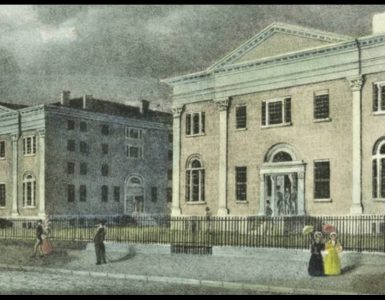
Lacy found a better paying position teaching the children of Daniel Allen, a Presbyterian elder who served a congregation pastored by John Blair Smith. Smith was struggling to equitably divide his time between pastoral ministry to the Briery and Cumberland congregations while serving as president of Hampden-Sydney College. The college’s first president had been John Blair’s brother, Samuel Stanhope Smith. Drury became a Christian through influences from John B. Smith and the Allen family. His next teaching engagement was with the children of Colonel John Nash who was a founding member of the board of Hampden-Sydney College and he fought in the Revolution. One of the advantages Lacy enjoyed because of his friendship with John B. Smith was getting with him a few hours each week for tutoring in an array of subjects. Drury acquired considerable ability with Latin and Greek and by the age of twenty-three was a tutor for Hampden-Sydney College and was the first person to teach in the school without a formal college education. From the time he became a Christian he hoped to be a minister and President Smith not only taught him general subjects but theological topics as well. Drury Lacy was taken under care of Hanover Presbytery in April 1787, then licensed in September. He would be ordained in October the following year.
J. B. Smith became frustrated with juggling pastoral work and the college presidency and wanted to resign. However, instead he tried for a year to fulfill Hampden-Sydney’s request that he continue in office with Lacy coming on as vice president. Lacy took on some of Smith’s duties freeing him for pastoral work and guest preaching, but in 1789 Smith resigned the presidency to dedicate all his efforts to his congregations. On the 25th of December 1789, Lacy married Anne, the daughter of William Smith of Powhatan County. For several years after their marriage he continued pastoral work supplying churches within the area including a part-time term for Briery Church, 1792-1793, where both the Smiths had ministered. He was also a leader of revival meetings at the Peaks and Pisgah Churches during the communion season and supplied worship services for the churches at Hampden-Sydney College, Charlotte Courthouse, and Buffalo. During the revival at the college which influenced not only the college but also the community, Lacy worked with Nash Le Grand to bring him to Christ. Lacy was intermittently pastor or supply for Cub Creek Church for about ten years after the Revolutionary War ended. He continued at Hampden-Sydney as vice president (also effectively filling the president’s office) until he left in 1796 to live on a farm he named Mount Ararat.
There was not an ark on Ararat but there was a classical school started by Lacy so he could continue at the lectern for the remainder of his life. The school was residential with many pupils coming from considerable distances to live with his family or neighbors while studying. Lacy was known for his ability with Greek and Latin and families selected him to teach their children because of his language skills. Some of Lacy’s students went on to become ministers, lawyers, public servants, and doctors. Just as James Hall was important for North Carolina education, Drury Lacy was influential for Virginia education.
Lacy was often a commissioner representing Hanover Presbytery in the General Assembly and was moderator of the General Assembly in 1809. He was the clerk of Hanover Presbytery for a number of years and was known for his exquisite, flowing, even artistic handwriting.
Drury Lacy was afflicted with a calcification, possibly a gall or kidney stone, that caused him to seek medical help in Philadelphia. While there he lodged with an old friend named Robert Ralston. The physicians consulted recommended surgery which was accomplished successfully, but after a few days of improvement Lacy took a turn for the worse and passed away December 6, 1815 at the age of fifty-seven. Anne had stayed home and unbeknownst to Drury was ill with a fever that led to her predeceasing him. Drury Lacy was interred in the burying ground of Second Presbyterian Church in Philadelphia. The Lacys had six children—three sons and three daughters; two of the sons became Presbyterian clergymen, the third was a physician. One son named Drury Lacy (1802-1884) was president of Davidson College in North Carolina.
The following descriptions of Lacy from W. B. Sprague’s Annals of the American Pulpit, vol. 3, give a sense of Lacy’s person and presence since a portrait was not located. Anne, the wife of John Holt Rice, knew Drury when they were children and they continued to be friends as adults. Her letter of remembrance for Lacy includes the following:
His person was very large and imposing and his countenance, when lighted up, was most expressive and delightful. I can in no way bring him more plainly before me, than by remembering him when he was listening with delight to Dr. Archibald Alexander’s eloquence as he gazed with his deep blue eyes over the congregation with tears streaming down his cheeks, to notice the effect which it produced on him. His own preaching was simple and natural, and sometimes very eloquent. His prayers, especially in his latter years, were peculiarly fervent. He seemed, like Abraham, the friend of God, most reverently and devoutly speaking, as if face to face, to his Heavenly Father.…My recollections of him, both in the pulpit and out of it, are most grateful and affectionate.
Archibald Alexander also remembered Lacy. The two were often on committees and commissions together for Hanover Presbytery. Alexander observed him often and provided this loving but discerning perspective on his friend.
His preaching was calculated to produce deep and solemn impressions. His voice was one of extraordinary power. Its sound has been heard at more than a mile’s distance. His voice was not only loud, but clear and distinct. In the largest assemblies convened in the woods, he could always be heard with ease at the extremity of the congregation. On this account, Mr. Lacy was always one of the prominent preachers at great meetings. His preaching was also with animation. His address to his hearers, whether saints or sinners, was warm and affectionate. Indeed, according to his method of preaching, lively feeling in the speaker was an essential thing to render it either agreeable or impressive. Mr. Lacy was therefore a much more eloquent and impressive preacher on special occasions, when every circumstance combined to wind up the mind to a high tone of excitement, than in his common and every day discourses in which he was always evangelical, but sometimes flat and uninteresting. Upon the whole, it may serve to characterize his preaching, to say that it was better suited to the multitude, than to the select few who possess great refinement of taste; better adapted to satisfy and feed the plain and sincere Christian, than to furnish a feast for men of highly cultivated intellect. He enjoyed the unspeakable pleasure of knowing a considerable number of humble, exemplary Christians, who ascribed their first impressions to his preaching or conversation; for he excelled in the art of conversing on the subject of experimental religion. To inquirers and young converts he addressed himself in private in a very happy manner, which was to them often the means of important spiritual benefits. And on general subjects he conversed in an agreeable and instructive manner.
Alexander’s comment that Lacy’s sermons were “flat and uninteresting,” is blunt. It seems that despite Lacy’s “silver voice” his content and delivery was not as polished as some listeners desired.
Lacy published A Sermon, Preached on the Occasion of the Death of the Rev. Henry Pattillo: to his former Congregations in Granville County, North Carolina, October 11th, 1801. Sprague mentioned that Lacy published a book on “the great revival in Kentucky and the strange appearances connected with it,” but I could not locate it. A letter by Lacy to one concerned about sin and repentance was published in The Virginia Evangelical and Literary Magazine, 1820, is available for download on Confessional Presbyterian, HERE. The site has distinguished the two Drury Lacy men as Sr. and Jr. In the past such designations were not often used which makes it easy for a historian to confuse one generation with another.
Barry Waugh
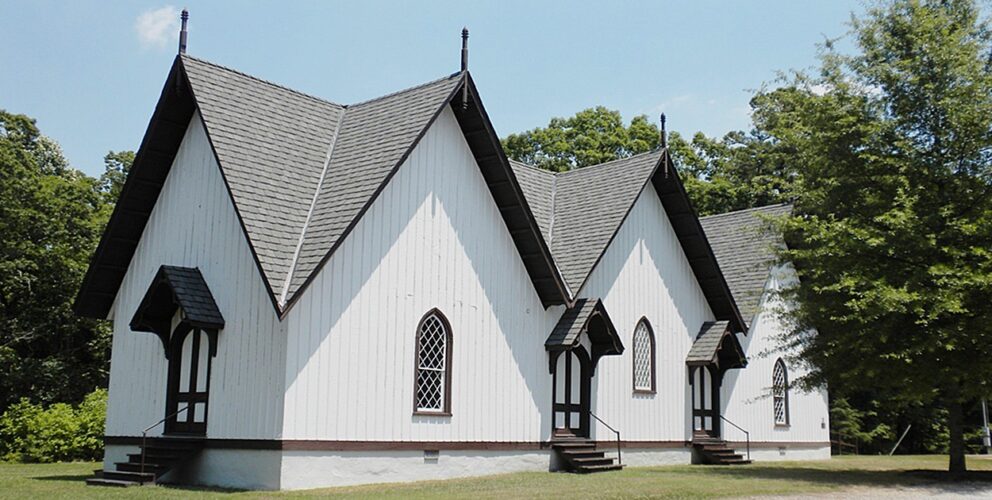
Notes— The following is from the Hampden-Sydney College website, “One will see Sydney spelled both with an i and a y in various documents and on different plaques about the campus. Algernon Sydney himself spelled it both ways but more often with a y. On the diplomas in Latin an i is used – there is no y in the Latin alphabet. Dr. Eggleston, President 1919-1939, finally standardized spelling the name with a y in October 1927.” See, The Naming of Hampden-Sydney College. The picture of Briery Church in the header was taken by the author. In addition to William B. Sprague’s Annals of the American Pulpit, vol. 3, sources used for this post include, A Manual for the Members of the Briery Presbyterian Church, Virginia, compiled by J. W. Douglas and published in Richmond, 1828, it was reprinted in 1971 by Thomas P. Hughes, Jr., Memphis, Tennessee; Encyclopedia of Virginia Biography, volume 2, 152-53, provides a short biography; Bulletin of Hampden-Sidney College, 7:4, January 1913, includes “Centennial Address Delivered June 14, 1876 by The Hon. Hugh Blair Grigsby,” which has an entry for Lacy on pages 21-23; Cub Creek Church and Congregation, 1738-1838, by Elizabeth Venable Gaines, 1931; and William H. Foote, Sketches of Virginia. Second Series, 1856, reprinted by Sprinkle Publications, 2007, has a number of mentions of his name. See also, Alfred J. Morrison, Hampden Sidney; Dictionary of Biography, 1776-1825, By the College, 1921. NCPedia has a brief biography of Drury Lacy, Jr., HERE.