

 bwaugh
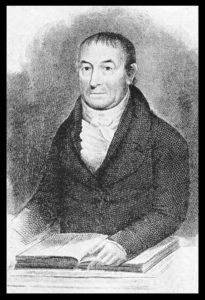 Jonas was born to Hannah (Halstead) and John Coe on March 20, 1759 in New Hampstead, New York. He was a grandson of Samuel Coe who had emigrated from Suffolkshire, England to the American colonies about 1712. One ancestor was martyred, Roger Coe. He was burned by Queen Mary, September, 1555. Jonas and four of his brothers joined their father fighting for independence during the American Revolution. After studies at home directed by tutors he entered Queen’s College (Rutgers) in New Jersey. During vacations from college he went home to work on the farm and read in preparation for the next year. He graduated with the class of 1789. Believing he was called to the ministry, he was pleased to receive theological instruction from John Rodgers of the Collegiate Presbyterian Church in New York City. He was taken under care by the Presbytery of New York October 11, 1790, then the following year he was licensed to preach in October.
The city of Troy in New York was originally two villages—Troy and Lansingburgh, which were separated by about three miles. During the earliest days a number of residents in both villages wanted to have a church but neither the Troy nor Lansingburgh congregations had sufficient funds to support a full time minister. As was often done, the two villages combined their funds for a single call. Jonas’s call would include leading worship in each location on alternate Lord’s Days. He accepted the call and on October 11, 1792, he was dismissed from his presbytery for reception by the Presbytery of Albany on February 20, 1793. He stood examination before the presbyters for two days before being accepted for ordination and installation on June 25. At the time he started ministry to the congregations much of the northern area of the State of New York was wilderness. As settlements were established at various locations, he often visited them as a missionary to help settlers have worship services and establish churches. During one of these excursions he went as far north as Plattsburg (about 150 miles due north of Troy). By 1803, the Troy congregation had grown in membership and finances sufficiently that the combined ministry to Troy and Lansingburgh ended leaving Coe to pastor the Troy congregation. As was common in the early years of the United States many churches experienced revivals. Between 1815 and 1818 two-hundred-sixty members were added to the Troy Church during a season of revivals.
In 1817 Coe was selected a commissioner to the General Assembly that convened in First Church, Philadelphia. He was elected moderator succeeding his friend, Samuel Blatchford. Some of the issues addressed by the Assembly included whether an individual that left a church and united with a congregation of another denomination should be subject to discipline. This was assigned to a committee but unfortunately its report and the Assembly’s decision was not located in the published minutes. The Presbyterians continued to be interested in funding education for “poor and pious youth” so they could enter the ministry. The previous Assembly had requested presbyteries to report regarding their opinions on the subject. The reports were assigned to a committee at the Assembly that reported many presbyteries had their own programs and Moderator Coe appointed a committee to devise “a plan on this subject.” Alteration of some presbytery bounds were considered with one change establishing the Synod of Tennessee from the Synod of Kentucky. Also, a minister, George Bourne, appealed the decision of the Presbytery of Lexington (Virginia) deposing him from the ministry. The assembly agreed that the penalty had been too severe and instructed “the Presbytery commence the trial anew.” An attempt to allow printers to print the Confession of Faith on their own without requiring any payment for use of the copyrighted material was thwarted as “inexpedient” because the trustees of the Assembly already had an edition in process. The copyright defending decision did not matter because publishers went ahead and published pirated editions. Later in the history of the Confession it became necessary to compile a new edition via analysis of previous editions. Imagine a world in which the Confession of Faith had sufficient promise of profit for printers to pirate its text. There was considerable discussion about review of the Synod of Philadelphia minutes with respect to a pastoral letter concerning Hopkinsianism and revivals. With respect to missions, the committee recommended cooperating with the Reformed Dutch, Associate Reformed, and other denominations “holding to the same creed” for the purpose of forming a society for foreign missions. The report was adopted. Finally, an appeal came from the Presbytery of West Tennessee.
Can a man, consistently with the rule of moral duty contained in the word of God, marry his brother’s widow, or does its impropriety arise from positive laws contained in the Bible?
The question was given to a committee to bring a report to the 1818 General Assembly. The question of near-kin marriages came up repeatedly for Presbyterians during the antebellum years then reoccurred in the 1880’s resulting in a sentence in the Westminster Confession of Faith, 24:4 being removed. Jonas Coe was moderator of the sessions that extended for two weeks from May 15 to 28. The following year he delivered his moderator’s sermon from the last clause of Romans 11:13, “I magnify my office.”
It was Dr. Coe’s hope that he might not outlive his usefulness—nothing distressed him more than the idea of becoming a useless clergyman and a burden to his congregation, family, and friends. He was laid up from ministry for six weeks before he died July 21, 1822 at the age of sixty-three. His Funeral Sermon was preached by his friend Samuel Blatchford. A sign of his reputation among ministerial colleagues was the twenty-five clergymen attending his funeral.
Dr. Coe’s first wife was Eliza Hunting Miller whom he married September 27, 1791. She was born in Duchess County, New York, April 10, 1778, and died on April 19, 1805. On May 14, 1810, he married Abigail Wallace who was at the time living in Lansingburgh. She survived Jonas and at the time of Sprague’s biography in 1857 she was in her eighty-sixth year. Three children were born to Jonas and Eliza, but he and Abigail had no children. The eldest son, Edward, graduated Union College in 1815, then studied Law, before establishing a practice in Troy. He died February 12, 1828. Another son, John, was born in January 1800, graduated Union College in 1817, and then became a student in Princeton Theological Seminary that fall. He was licensed to preach by the Presbytery of Troy in October 1820. After working for several years in missions, he was ordained and installed pastor of the church in Whitehall, New York. John died just a year after his father.
Jonas Coe received an honorary Master of Arts from the College of New Jersey (Princeton) in 1792, and another one from Union College in 1797. The College of William and Mary in Virginia and Middlebury College in Vermont each honored him with a Doctor of Divinity. The honorary degrees give an idea of how much he was appreciated by his peers.
He published A Sermon, Delivered before the Military Officers, Apollo Lodge, and a Large and Respectable Number of the Citizens of Troy, January 12th, 1800. In Consequence of the Death of Lieutenant-General George Washington, by Jonas Coe, A.M., Minister of the Presbyterian Church in Troy, Troy: Printed at the Budget Office, by R. Moffitt & Co., 1800. His sermon remembering General Washington was one of many because not only Presbyterians but ministers of other denominations as well respected his military and political leadership. Also published was, A Sermon Delivered at the Installation of the Rev. Samuel Tomb to the Pastoral Charge of the Presbyterian Church in Salem [Massachusetts], February 19th, 1806, Salem: Printed by Dodd and Rumsey, 1806.
Barry Waugh
Notes– Sources include: Catalogue of the Officers and Students of Middlebury College in Middlebury Vermont, and of Others Who have Received Degrees, 1800-1900, compiled by Walter E. Howard and Charles E. Prentiss, 1901; William B. Sprague, Annals of the American Pulpit, vol. 3; Princeton University General Catalogue, 1746-1906, 1908; V. L. Collins, editor, Proceedings of the Centennial Anniversary of the First Presbyterian Church, Troy, N.Y., December 30 and 31, 1891, Troy: Troy Times Printing House, 1892; pages 31-59 provide information supplied by Coe’s grandson including sermons. The header image is from the New York Public Library Free-Use Digital Collection. If you are interested in reading more about the history of near-kin marriages in the Presbyterian Church, see the author of this site’s dissertation available on the Log College Press site.