
 bwaugh
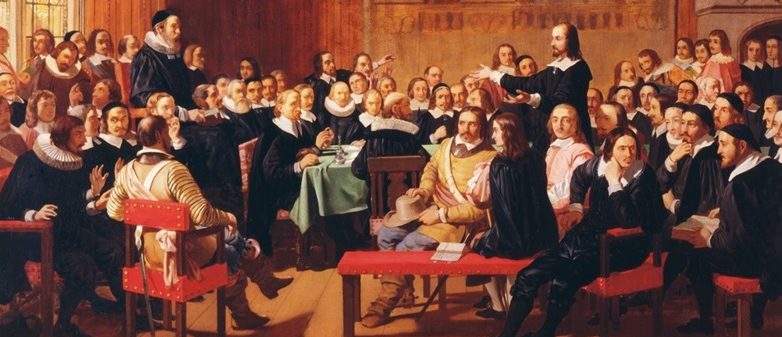
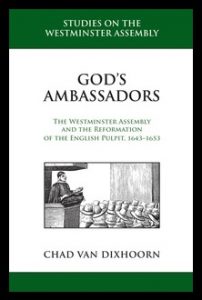 The period beginning with Henry VIII then continuing through Lord Protector Oliver Cromwell was a tumultuous era of England’s history. Henry VIII’s quest for a male heir led to a break with the papacy and establishment of the Church of England, and when his Reformation-minded adolescent son Edward succeeded him, England pursued committed Protestantism during his brief reign. However, the papacy returned with Mary becoming queen and she declared open season on anyone or anything even hinting of Protestantism. With her death, the forty-five-year rule of astute and savvy Elizabeth settled the dominion, but then reign of the Stuarts began with James ruling first followed by Charles who suffered execution during the English Civil War. As the war raged in the land, the Westminster Assembly convened in the Jerusalem Chamber of Westminster. Confessionalists of a presbyterian polity persuasion remember the Westminster Assembly for its confession and catechisms, but Chad Van Dixhoorn’s God’s Ambassadors: The Westminster Assembly and the Restoration of the English Pulpit, 1643-1653, 2017, presents a significant little-known aspect of the work of the assembly. The book draws upon ancillary documents located by the author during his decade of transcribing the often-cryptic scrawl and early-modern shorthand used for the minutes of the assembly, which he published in five volumes as The Minutes and Papers of the Westminster Assembly, Oxford University Press, 2012.
The quality cloth-bound monograph issued by Reformation Heritage Books is attractively jacketed with a green trimmed dust cover decorated on its front with a simple image of a Puritan minister preaching. Three sections organize the fourteen chapters of the book—“Blind Guides and Scandalous Ministers,” “A Reforming Assembly,” and “In Theory” addresses ministers’ qualifications and the content of sermons. The author says that the organization of his book is the best way he could present the subject for efficient communication.
So, what is this book?… The best that I can offer by way of answer is that it is a three-legged treatment of the Westminster Assembly’s endeavor to reform the pulpit of England from 1643 to 1653. It first tells the story of the puritan quest for a reformation in preachers and preaching and how the Westminster Assembly tried to play a part in that movement. The second part of the book looks at the assembly’s own reform effort, tracing its debates and exploring key documents on the subject of preaching. … The final cluster of chapters seeks to set forth the rationale behind the assembly’s writings and reforms, both in terms of biblical exegesis and practical theology. (xvii-xviii)
The book’s conclusion is at the end of section three, then there is an epilogue addressing the current state of preaching and ministry that is followed by an appendix with three Westminster Assembly documents. A bibliography and index are included. A particularly handy aspect of the book is the use of summary tables for a text-message presentation of some aspects of the author’s work.
Several years ago while reading portions of the published journals of Parliament from the era of the Westminster Assembly, I was surprised by the number of times I came across actions taken regarding ministers and ordination. It was an example of the uncomfortable confusion of church and state that characterized the era of the Assembly and the English Civil War. The war fought on the fields of the nation was similarly seen between Parliament and the Westminster Assembly as its attendees walked on egg shells realizing how a misstep could lead to grim consequences. However, despite parliamentary regulation of the assembly, the men meeting in the Jerusalem Chamber were able not only to debate and compose the Westminster Standards but also spend a considerable amount of their time examining ministers. Van Dixhoorn notes that the state of preaching in the land was dismal and its cause was at least partially due to the Church of England’s network of clerics which was susceptible to corruption via a few coins judiciously distributed here and there to obtain better benefices and bishoprics. The book God’s Ambassadors shows how the assembly’s work regarding pastoral ministry made capable preachers available to the land as it took on the extensive work of examining and ordaining ministers.
One aspect of God’s Ambassadors that I found particularly interesting is how little the qualifications for a minister, such as his ordination trials and his pastoral abilities, have changed in the more than 350 years since the assembly. Basically, the procedures used, for example, by the Presbyterian Church in America, are very much the same as the stipulations provided in the documents produced by the assembly. The assembly’s document, The Directory for Ordination, has been included by the author as the second selection of the appendix. Directory includes some content which might constitute good revisions for current church forms of government. It is not uncommon for church members and officers to wonder why Presbyterians do things the way they are done, so Dr. Van Dixhoorn’s explanation of the history of the assembly’s work regarding preaching and ministry may provide the answers needed.
The author referred several times to The Art of Prophesying by the Elizabethan Cambridge Puritan, William Perkins. The use of the word “prophesying” may be confusing today given its common meaning of forth-telling, but it was an accepted synonym for preaching in the seventeenth century. Perkins’s message about preaching is really quite simple. A sermon should include four aspects for any Bible text expounded—read the Word, explain the Word, make points of doctrine from the Word, and apply the Word (see 27-28, Van Dixhoorn). The assembly was sensitive to the Perkinsian method and it governed the thinking of some commissioners with respect to what was expected of ministerial candidates. Sometimes ministers today consider themselves followers of the puritan preaching method but they lose sight of the importance of simplicity—read the Bible passage to the flock, tell them what it says, explain its doctrine succinctly, and then tell them what to do with it at work or in the home on Monday.
Chad Van Dixhoorn’s God’s Ambassadors fills a gap in our understanding of the Westminster Assembly, and given the amount of research the author has accomplished with respect to the assembly it is likely other gaps will be filled as he publishes other thematic studies. God’s Ambassadors is informative, clearly written, and provides new significant material regarding the Westminster Assembly in an area that might not otherwise be associated with their work.
The copy of God’s Ambassadors read for this review was purchased by the reviewer. It appears that this title is currently available only in e-book form from Reformation Heritage Books.
This review was first posted November 8, 2017. Previously Dr. Van Dixhoorn published Confessing the Faith: A Reader’s Guide to the Westminster Confession of Faith, Banner of Truth, 2014, and more recently he has compiled previously unpublished work by a central figure at the Westminster Assembly, John Lightfoot’s Journals of the Westminster Assembly, Oxford University Press, 2023. Scheduled for release October 2026 as contributed to by present and past faculty of Reformed Theological Seminary and published by Crossway is The Westminster Confession of Faith: A Comprehensive Commentary on Its History, Theology, and Application, edited by J. V. Fesko, John R. Muether, and D. Blair Smith. Crossway has provided information about the book HERE.
Barry Waugh
The header image is gratefully used courtesy of Reformation Art.