
 bwaugh
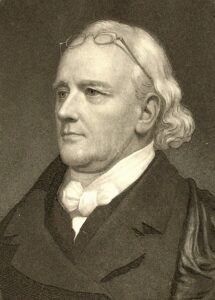 Francis was born June 28, 1774 the son of David and Mary Herron. David was a ruling elder in the Middle Spring Church in Shippensburg, Pennsylvania. The family lived about three miles northwest of the church on what was known as Herron’s Branch. Francis’s parents were Scotch-Irish and were appreciated locally for their devotion to and work for their church. Francis was trained in a Christian household, taught the Westminster Catechism, and sat under the ministry at Middle Spring Church of the Rev. Robert Cooper, pastor 1865-1897. David Herron’s devotion to the Lord and his sense of humor have been illustrated in the following account of an incident involving Pastor Cooper.
Dr. Cooper had the custom of calling the roll of the members every Sabbath morning and noting the absentees whom he visited the following week. He also required the members to sing one of the Psalms in course on each Sabbath morning. So on a certain communion Sabbath, solemn days were these, David Herron’s name was called, and though he was one of the most regular, reliable and godly members of the session, there was no response. The clerk rose at his desk and called again, “David Herron!” But still there was no answer. Early the next morning, long before the hour of public ministry on Monday, Dr. Cooper was seen trotting briskly up the creek road past the homes of the Brady’s, Strain’s, and Cambridge’s on to the house of David Herron, he entered the home quickly and meeting Mr. Herron, he said in a somewhat abrupt way, “Not at church yesterday! What is your excuse?” “Well, Doctor, you know your rules; yesterday morning I rose earlier than usual, after breakfast read a short chapter and offered prayer, and then, with my family, we commenced to sing a Psalm, as you require of us on every Lord’s Day, the one in course being the 119th. We could not violate your rule, we did our best, but were not able to finish it until in the afternoon.” Whereupon the Doctor arose, adjusting his wig, and placing his hand upon the shoulder of his faithful elder, said, “David your excuse is a good one, I am perfectly satisfied, and then rode home” (Presbytery of Carlisle, see sources below).
His early education was acquired through what today would be called home schooling as he prepared to enter Dickinson College for its classical curriculum in preparation for theological training. He graduated from the Carlisle institution May 5, 1794. He at once began to study theology when he went home under the direction of Pastor Cooper. He was licensed to preach by the Presbytery of Carlisle, October 4, 1797.
Shortly after his licensure, Herron, Rev. Joseph Mahan, and the Rev. Mathew Brown, a classmate from Dickinson, started on a missionary tour in the western regions on horseback. On Friday evening of the first week they reached the tavern of Six-Mile Run, near Wilkinsburg, a suburb of Pittsburgh. During his stay there Herron was prevailed upon to spend the Sabbath and preach to as many as could be gathered, which he did while standing under the shade of an apple tree while shooing insects. His two friends passed on to Pittsburgh and Mahan led worship for First Presbyterian Church. Herron then continued on alone in his journey leaving Pittsburgh to head westward as far as Chillicothe, Ohio. A large portion of the route of his journey was dangerous during that time in history because of thieves and the possibility of being attacked by Indians. His only companion and guide was one of the early frontier settlers, who had only once previously passed over the same route. For days they found no human habitation or shelter, two nights they encamped with the Indians near what is now Marietta, Ohio.
On return from Ohio, Herron again visited Pittsburgh, then a village of less than two thousand inhabitants, without pavements, stage coaches, or other public improvements. There was only one church building, a crude log structure, that stood upon the lot where the more substantial First Church would later be constructed. He discovered that the keeper of the tavern where he lodged was an acquaintance from the past, and at his request, Herron consented to preach to a congregation of less than twenty people that gathered in the log church. He went on to visit other locations and churches including the Buffalo Church, in Washington County, Pennsylvania, where the people were so pleased with his ministry that they gave him a call to become pastor. He was advised to accept the call by his friends, but when he returned home he found a similar call awaiting from the Rocky Spring Church, which he accepted. He was ordained by the Presbytery of Carlisle and installed pastor of Rocky Spring Church April 9, 1800. It was a spiritually strong congregation blessed with a large and substantial building for services. In 1802, he married Elizabeth, who was the sister of his friend Matthew Brown’s wife and the daughter of a lawyer named Alexander Blain. The first decade of Herron’s ministry was a period of congregational growth and a time in which he honed his pastoral skills.
In the year 1810, Francis Herron went to Pittsburgh to visit family and while there he was invited to preach in the First Presbyterian Church, which had been left vacant by the death of Pastor Robert Steele. The people were greatly pleased with Francis’s ministry, so when he returned to visit Pittsburgh on a later occasion he was asked to preach again. The result of his two supply opportunities at First Church was the congregation issuing him an unanimous call to become pastor. He accepted the call, loaded a wagon with his property, and took his family to Pittsburgh after his pastoral relation with Rocky Spring was dissolved April 3, 1811. Herron was installed pastor by the Presbytery of Red Stone in First Church June 18, 1811. His salary was six-hundred dollars per year.
When Francis Herron came to understand the spiritual condition of the congregation, he was challenged by the difficult situation before him because the people were not maturing in the faith. The experience of his years at Rocky Spring became invaluable for the new call. He approached his work with a two point plan. First, he was to preach the gospel of Christ with pointed application to the hearts and consciences of his hearers, and second, he would carefully expose their lack of spiritual growth with compassion and concern. He persevered according to this plan. Another tool he used to bolster his shepherding and strengthen the congregation was instituting a prayer meeting, which was something he found beneficial for the congregation at Rocky Spring. But this met with disapproval from even the best of his people; he was accused of introducing an innovation out of accord with proper worship. Husbands and fathers prohibited their wives and children from attending and Dr. Herron was told that the prayer meetings had to stop. But Pastor Herron stood his ground telling the people that the meetings would continue and that those who did not want to attend did not have to, but he contended that he had the right to follow his conscience regardless of opposition. The challenges overcome to continue the prayer meeting was a turning point for his ministry and it gained him new respect from the congregation.
In 1825 the General Assembly resolved to establish a theological seminary in the West and appointed a committee to select a suitable location. Also, a committee was chosen consisting of twenty-one ministers, including Herron, and an additional nine members who were elders to serve as directors for the next year. During the next twelve months, Herron promoted locating the seminary in the Pittsburgh area. So, when the 1826 assembly convened in First Church, Philadelphia, things were looking good for his plan to locate the seminary in Allegheny Town just across the Allegheny River from Pittsburgh. However, testimony to the controversy that developed at the General Assembly over the proposed seminary were recorded by the stated clerk in the minutes using those few unfortunately familiar words to presbyters, “discussed at considerable length.” While the Presbyterians of the three-rivers region had been promoting their site, other locations were touted by presbyters from Cincinnati when they proposed Walnut Hills, and the Hoosiers had their own plans as they lobbied for Charleston (or Charlestown), Indiana. The 1826 meeting resolved to decide the location the next year from the three proposed sites. When the 1827 Assembly convened, Francis Herron was elected moderator and presided while the commissioners selected Allegheny City. Once the Allegheny City location was chosen, Herron became the chief advocate for the financial support of Western Seminary. He served the school as vice president of the board of directors, 1825–1827, then president of the board, 1827–1860, and finally as a trustee, 1847–1860.
In 1850 after having pastored the Pittsburgh church for forty years, Dr. Herron asked to be relieved of his pastoral charge. The many years of service not only to his congregation but also to the presbytery, synod, and general assembly had weakened him greatly. His request was granted, then a successor was chosen with his approval, and finally he was relieved of pastoral duties to enjoy what would be called today retirement. One of his special privileges occurred in 1853 when he delivered the last sermon ever to be preached in the church building where he had served for his entire ministry at First Church. The congregation had built a new building and the old one was no longer needed. Even though the sermon manuscript was lost in a fire, a snippet has remained.
And now I wish to say, in conclusion, my career in the gospel ministry is drawing very near to a close. And having, in my feeble manner, preached “the glorious gospel of the blessed God,” for more than half a century, to my fellow sinners, both here and elsewhere, I wish it to be recorded and remembered, that I am not ashamed of the gospel of Christ. And would to God that it was written as “with a pen of iron and with a point of diamond,” on every heart, both of saint and sinner, that this gospel is the only remedy for the ruined creature, man. And, my fellow sinners, if you are ever saved from the ruins of apostasy, you must be saved by this gospel, according to God’s plan of salvation through Christ, to whom be glory for ever. Amen.
Francis Herron passed away December 6, 1860. In June 1855, his wife Elizabeth died after more than fifty years of marriage. The Herrons had several children. He was a trustee of Jefferson College, 1817-1849, and was honored by its board with the Doctor of Divinity in 1824. As well as being on the board of Western Seminary as previously mentioned, he also served on the Board of Directors of Princeton Seminary, 1812-1829, resigning shortly after Western opened. He published in The Presbyterian Preacher, vol. 3, no. 10, March 1835, “The Duty and Reasons of Christian Diligence,” using Philippians 2:12, 13 for his text; another title is, An Address Delivered in the First Presbyterian Church on the Sabbath Evening of January 27, 1839 to the Young Men of the City of Pittsburgh, Pittsburgh: E. B. Fisher, 1839.
Barry Waugh
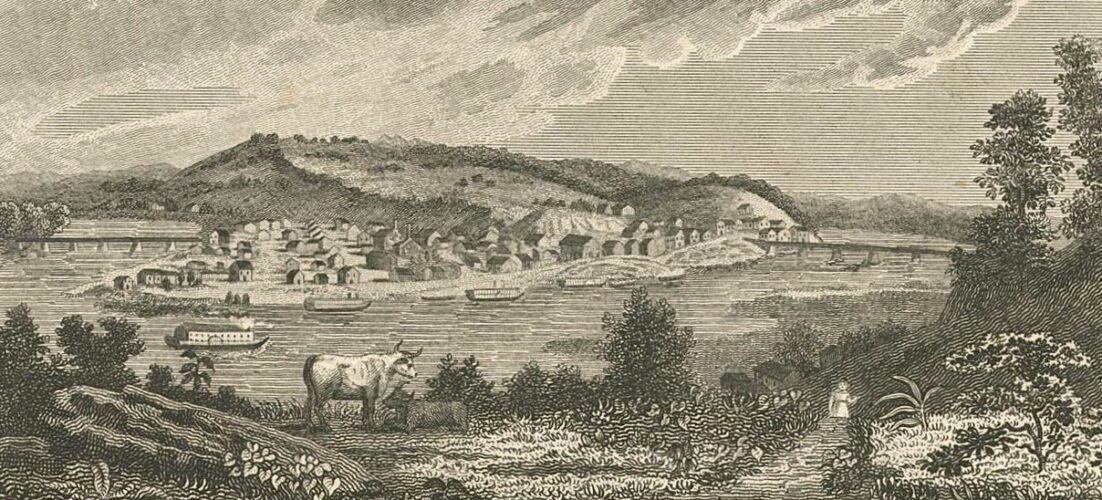
Notes—The header shows Pittsburgh as published by N. & G. Guilford of Cincinnati which ended business sometime in the 1830s. The image is from the digital collection of the New York Public Library. William M. Paxton, published two memorials delivered by him in memory of his friend in, Two Discourses Upon the Life and Character of the Rev. Francis Herron, D.D., Pittsburgh: Robert S. Davis, 1861, which includes memorials from the church session and the board of Western Theological Seminary. Another biography is found on pages 100–110 of The Centennial Memorial of the Presbytery of Carlisle, in Two Volumes, Vol. II—Biographical, Harrisburg: Meyers Printing and Publishing House, 1889, however this biography is essentially a summary of Paxton’s work. Also used was, The Middle Spring Church, Founded in 1738, United Presbyterian Church in the U.S.A. Shippensburg, Pennsylvania, Two Hundred Twenty-fifth Anniversary, 1963; and Centennial Volume of the First Presbyterian Church of Pittsburgh, Pa. 1784-1884, Pittsburgh: Wm. G. Johnson & Co., 1884.