
 bwaugh
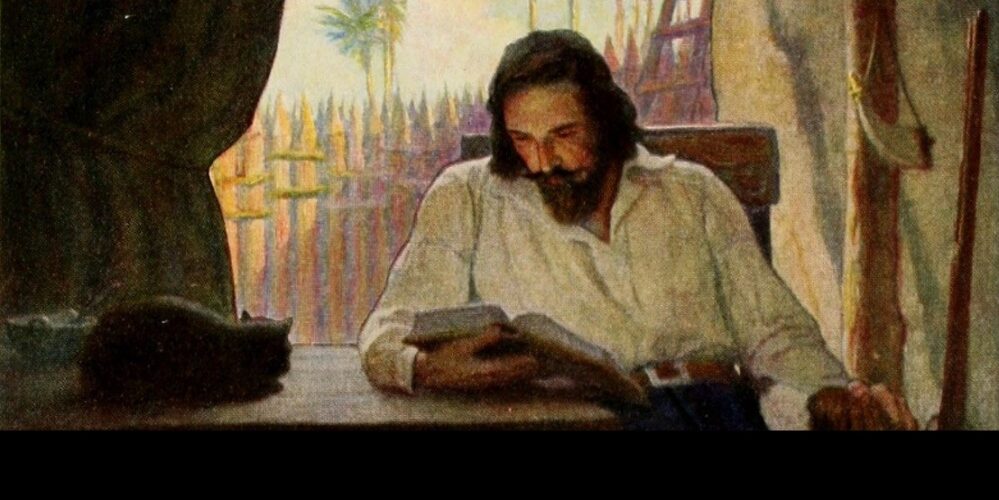
 The header is an illustration from one of the many editions of Daniel Defoe’s The Life and Strange Surprising Adventures of Robinson Crusoe, of York, Mariner. The picture visualizes the following text as Crusoe recovers from an illness. In the first sentence “I missed the fit for good and all,” is an archaic idiom meaning he had suffered the final attack of his illness and was recovering.
July 3.—I missed the fit for good and all, though I did not recover my full strength for some weeks after. While I was thus gathering strength, my thoughts ran exceedingly upon this Scripture, “I will deliver thee” [Psalm 50:15]; and the impossibility of my deliverance lay much upon my mind, in bar of my ever expecting it. But as I was discouraging myself with such thoughts, it occurred to my mind that I poured so much upon my deliverance from the main affliction, that I disregarded the deliverance I had received; and I was, as it were, made to ask myself such questions as these, viz., Have I not been delivered, and wonderfully too, from sickness? from the most distressed condition that could be, and that was so frightful to me? and what notice had I taken of it? Had I done my part? God had delivered me, but I had not glorified Him; that is to say, I had not owned and been thankful for that as a deliverance; and how could I expect greater deliverance?
This touched my heart very much; and immediately I kneeled down, and gave God thanks aloud for my recovery from my sickness.
July 4.—In the morning I took the Bible; and beginning at the New Testament, I began seriously to read it, and imposed upon myself to read awhile every morning and every night, not tying myself to the number of chapters, but as long as my thoughts should engage me. It was not long after I set seriously to this work, but I found my heart more deeply and sincerely affected with the wickedness of my past life.
The impression of my dream revived, and the words, “All these things have not brought thee to repentance” [c.f. Romans 2:4] ran seriously in my thought. I was earnestly begging of God to give me repentance, when it happened providentially, the very day, that, reading the Scripture, I came to these words, “He is exalted a Prince and a Savior, to give repentance, and to give remission” [Acts 5:31]. I threw down the book; and with my heart as well as my hands lifted up to heaven, in a kind of ecstasy of joy, I cried out aloud, “Jesus, Thou son of David! Jesus, Thou exalted Prince and Savior, give me repentance!”
Defoe’s book is considered the first English novel. It is a diary providing a first person narrative of the more than twenty-eight years Crusoe was a castaway on an island off the coast of South America. The novel has been compared to the diaries devout Puritans kept as reminders of God’s gracious providence directing their lives before they came to believe the gospel and then subsequently matured in the faith. A list of the hundred greatest novels of all time compiled by The Guardian places Don Quixote by Cervantes, considered the first modern novel, at number one, Pilgrim’s Progress by Bunyan at two, and Robinson Crusoe at three. It is believed Defoe was inspired to write Crusoe from the experiences of the Scottish seaman, Alexander Selkirk (1676-1721), whose story was recounted by Richard Steele in the journal The Englishman, December 3, 1713. The first part of Crusoe was released in April 1719 and by August three additional printings were completed as well as the second part titled, The Farther Adventures of Robinson Crusoe. The next year the third part was released with the title, Serious Reflections During the Life and Surprising Adventures of Robinson Crusoe. Trilogies are nothing new.
Having just passed the three-hundredth anniversary of Crusoe in 2019, the book has been published legally and in pirated editions numbering in the thousands and it continues to be a popular read. It was printed in French 1720, German 1720. Dutch 1721, Italian 1731, Danish, 1744, Swedish 1745, but not in Spanish until 1835. Editions have also been published in Polish, Arabic, Greek, Turkish, Finnish, Hungarian, Armenian, Hebrew, Welsh, Portuguese, and Persian among many others. One edition came from the presses in Latin which was used for a school textbook (i.e. an adventure story makes learning Latin more agreeable). Defoe’s book created what has been called Robinsoniades which are novels imitating Defoe’s plot that include castaways struggling to survive on isolated islands. An example is Swiss Family Robinson which was first published in German by Johann Rudolf Wyss. The book tells the story of a Reformed Church pastor and his family surviving on an island in the East Indies. And the last source affirming the importance of Defoe is the 720 pages of The Oxford Handbook of Daniel Defoe, 2024. It is hopefully clear that Robinson Crusoe is an important novel in the history of literature in general and English in particular.
So, who was Daniel Defoe and what was his background that contributed to his becoming an important literary influence?
Daniel was born to his mother Alice and father James Foe in 1660. The surname Defoe was adopted by Daniel in later life. James was a tallow chandler (candle maker) at the time of Daniel’s birth. The family were Dissenters with regards to Christianity. Dissenters, also called Nonconformists, did not participate in Church of England worship but instead were Congregationalists or Presbyterians, with the Foes preferring Presbyterianism. James and Alice, until her death when Daniel was ten, raised their son a Presbyterian and even hoped he might become a minister. James took the family to services at St. Giles Cripplegate where the Puritan leader Samuel Annesley was the dissenting Church of England cleric. Edmund Calamy in The Nonconformist’s Memorial, vol. 1, described Annesley as, “A most sincere, godly, and humble man. An Israelite indeed [John 1:47].” Annesley and two thousand other nonconforming clergy were ejected from their pulpits in 1662. These devoted men refused to abide by the Act of Uniformity requiring all Church of England clergy to follow the Book of Common Prayer. Accompanying ejection were other hardships suffered by Dissenters such as limited educational opportunities. Daniel could not attend Oxford or Cambridge but instead studied in the Academy on Newington Green directed by Charles Morton. One of Defoe’s classmates was Timothy Crusoe who became a Presbyterian minister and his surname likely inspired Defoe’s protagonist in Robinson Crusoe.
When schooling was completed, Defoe worked different jobs, became politically active, and boldly expressed his opinions as a pamphleteer. He participated in Monmouth’s failed Rebellion against King James II in 1685, and even armed himself with a sword cane to serve as a spy for his cause. He was not afraid to take on opposition and was fined, imprisoned, and spent time in the pillory for his political opinions. From 1704 until it was suppressed in 1713, he operated the newspaper Review to publish his sentiments in editorials. Defoe continued in journalism until Robinson Crusoe was published in 1719. His Dissenter Christianity comes through in Crusoe’s prayers and sense of dependence on God.
Other titles by Defoe relevant to the Church and Christianity are, The Shortest-Way With The Dissenters: Or Proposals for the Establishment of the Church, 1720, which is a humorous work advocating religious tolerance for Dissenters; Religious Courtship: Being Historical Discourses, on the Necessity of Marrying Religious Husbands and Wives Only, 1722, which teaches the importance of Christians marrying only Christians; Memoirs of the Church of Scotland, in Four Periods.…[etc.], 1717, is an account of the Covenanters and their struggle for religious freedom; The Family Instructor. In Three Parts. With a Recommendatory Letter by Reverend Mr. S. Wright, 1715, which was written to expose “the decay in family religion” and promote Christian teaching in the home; and finally, A Tour Through the Whole Island of Great Britain, 1724-1727, is in four volumes that include the importance of Christianity in society as well as information about local churches.
Two other works by Defoe that are significant and were both published in 1722 are A Journal of the Plague Year and Moll Flanders. The former title is an example of early historical fiction as it recounts the Great Plague of London in 1665, while the latter tells about the picaresque and criminal life of a woman born in prison. As one might expect, Flanders has a history of censorship because of her unlawful activity and promiscuity, but its censors did not comprehend Defoe’s portrayal of her struggle with sin and eventual repentance thanks to visits by a minister when she was in prison for murder. The minister worked to have her released to go to Virginia where she married and lived until returning to England. In the last line of the book Moll’s story ends with her awaiting her husband’s return
to spend the remainder of our years in sincere penitence for the wicked lives we have lived.
Daniel Defoe lived out his days writing and was graced with three-score-and-ten years as mentioned in Psalm 90:10. He passed away April 24, 1731. Mary Tuffley and Defoe enjoyed a lengthy marriage with eight children born to them. He is buried in London in the Nonconformists cemetery named Bunhill Fields where John Bunyan, John Owen, Isaac Watts, John Gill, and Thomas Goodwin are interred awaiting resurrection along with many other Dissenters. The obelisk memorial for him reads,
This monument is the result of an appeal, in the Christian World newspaper, to the boys and girls of England for funds to place a suitable memorial upon the grave of Daniel De Foe. It represents the united contributions of seventeen hundred persons. September 1870.
Barry Waugh
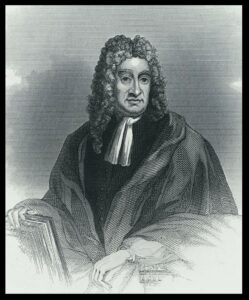
Notes—The header image is from Robinson Crusoe, Daniel Defoe, Illustrated by N. C. Wyeth, Philadelphia: David McKay Co., 1920. The Daniel Defoe portrait is an engraving circa 1890 from the New York Public Library Digital Collection. Selkirk’s story is in Richard Steele, ed, The Englishman: Being the Sequel of the Guardian, London: Printed by Sam. Buckley in Amen-Corner, 1714, 168-173; it is available on Internet Archive. Information about Defoe’s childhood is from F. Bastian, Defoe’s Early Life, London: The Macmillan Press Ltd, 1981. Also helpful is the biography of Defoe on Britannica Online by Reginald P.C. Mutter, and the piece in Concise Dictionary of National Biography to 1921, Oxford University Press, London: Humphrey Milford, [1930]. The issue of The Guardian with the statistics regarding the greatest novels is October 2003. Also used was the biography in Defoe’s A Journal of the Plague Year from Longmans’ English Classics series as edited by George R. Carpenter, New York, 1896; this version uses the second edition of Journal. On Place for Truth is an article about Defoe’s Journal by the Presbyterians of the Past author titled, “Lord, Have Mercy On Us,” which was written during the Covid pandemic. Other sources include: “Defoe, Daniel” in Antony Kamm, Collins Biographical Dictionary of English Literature, Glasgow: HarperCollins Publishers, 1993, and Bonamy Dobrée, English Literature in the Early Eighteenth Century, 1700-1740, Oxford: The Clarendon Press, 1968, which discusses Defoe at length and provides an extensive bibliography of his works, 631-635. The information about the editions in other languages is from “Robinson Crusoe: It Has Been Translated Into Many Languages,” published in the Los Angeles Herald, September 19, 1899, page 16. A critical edition of Crusoe has been published by Michael Shinagel, ed., Robinson Crusoe: A Norton Critical Edition, New York: W. W. Norton & Co., 1993. And another source is William Minto, English Men of Letters: Danial Defoe, 1879; reprint London: Macmillan and Co, Limited, 1902. The full title of Moll Flanders is as follows: The Fortunes and Misfortunes of the Famous Moll Flanders, &c. Who Was Born in Newgate, and During a Life of Continu’d Variety for Threescore Years, Besides her Childhood, was Twelve Year a Whore, Five Times a Wife (Whereof Once to her Own Brother), Twelve Year a Thief, Eight Year a Transported Felon in Virginia, at Last Grew Rich, Liv’d Honest, and Died a Penitent. Written from Her Own Memorandums.