
 bwaugh
 Wesley Fletcher Martin was born near Dalton, Georgia, May 3, 1850. He enlisted in the Confederate Army during the last year of the war. He would have been about fourteen years of age at the time he signed on. The commander of his regiment was Tennessean Major General Benjamin Franklin Cheatham who appointed young Wesley a courier because of his skill as a horseman, diminutive stature, and feather weight of only sixty pounds. His size made for a lighter load for the horse, greater speed, and a smaller target as he sat astride the saddle carrying military messages from commander to commander. It was a dangerous job to be a courier riding in the dark over unfamiliar ground, through woods, and fording streams knowing that at any moment the enemy might spot him. But he survived and several years after the war moved to Greenville, South Carolina, where shortly after arrival he married Miss Mattie C. Land of Anderson, January 20, 1878.
Martin became an active citizen of Greenville not only in his employment but also in his church and public service work. Greenville’s textile industry was expanding as mills opened in the Upcountry in abundance. Some mills were owned by Presbyterians such as E. A. Smyth who was the son of a minister of Second Presbyterian Church, Charleston, Thomas Smyth. The textile industry provided Wesley with twenty years of work as a cotton weigher. Along with his paying job he was an active and respected member of the Greenville Volunteer Fire Department. In 1884 Martin became captain of Lee Fire Company then twelve years later he was elected assistant fire chief serving a tenure of two years. Wesley and Mattie were charter members of Second Presbyterian Church when it was organized March 17, 1892. The congregation worshipped in the upper floor of the building at One Augusta Street which was the Farmers’ Alliance Cotton Warehouse (built 1890). Some members of the Martins’ church were mill owners and supervisors, so Wesley may have been seated in worship services next to his boss. But with advances in technology brought about by the use of electricity, Wesley would leave the textile industry for a new opportunity.
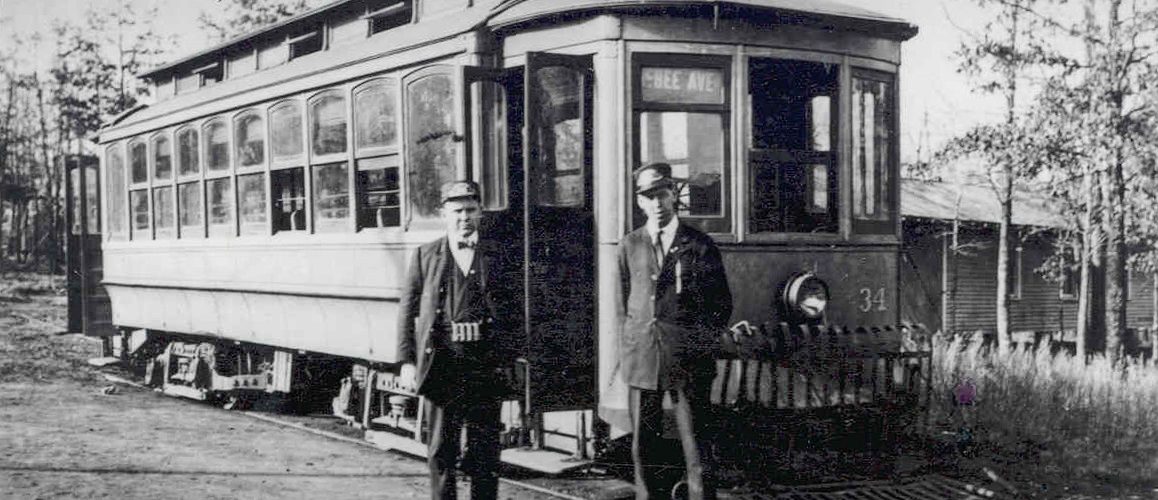
The increasing use of electric driven rail vehicles made its way to Greenville when the first trolley rolled through town in 1901. The first electric trolley line in South Carolina had opened in Columbia in 1893. Greenville’s first trolley run left the car barn on Broad Street, followed the track to Main where it stopped at the Mansion House Hotel to board dignitaries, then continued along the route ending its journey at Poe Mill. All went well except for a delay caused by the removal of muck from the tracks. The muck was animal manure and urine combined with bits of trash which if driven through could have been thrown up by the wheels to soil the fine clothing of the prominent passengers. Trolleys were not only used for transportation but were also appreciated as environmentally friendly devices supplanting horse traffic that produced oodles of odious output. When the trolley stopped at Poe Mill it signified that all Greenville routes led to textiles. Unfortunately, Poe Mill has joined the multitude of textile related industries in the South that closed their doors over the years as such manufacturing and its associated employment have been shipped abroad. The first roll down the rails in Greenville in 1901 would be followed by a multitude of others as the Main Street shopping district and expanding commercial areas of town facilitated transportation for economic growth.
The electric trolley system provided a new job for Wesley Martin when he left the mill to work for the Greenville Traction Company. One occurrence of note during Martin’s motorman years had significance for the baseball player Shoeless Joe Jackson. Jackson began playing organized baseball on the team from the textile mill that employed him. Tim Hornbaker in Fall from Grace recounts that while driving his trolley Captain Martin delivered to Jackson a custom-made bat just completed by a local craftsman. This was the famous bat which came to be named “Black Betsy.” The bat was a significant part of Jackson’s expertise and image. Joe could play without shoes, but he could not play without Black Betsy.
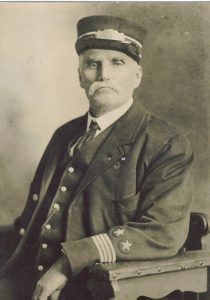
After service as a motorman then an inspector for the Southern Public Utilities Company (SPUC) for fourteen years, the management recognized Wesley Martin’s faithful service in 1915. The portrait of Martin above shows him proudly wearing his uniform with four stripes and two stars signifying he had worked for the SPUC for fourteen years. The Greenville Daily News noted Martin “ran the first car which ever moved over the lines of the Greenville Traction Company [predecessor of SPUC], nearly 15 years ago,” and that he “has been a faithful and efficient employee of the company.” Martin was distinguished for service as a motorman for ten years and for “having avoided any accident during that time.” For Martin to have achieved ten-accident-free years at the tiller of his trolley was quite an accomplishment. A motorized trolley car on rails could not swerve to avoid accidents; its only control was by increasing speed or decelerating with its not so effective brakes. A spooked horse, a child chasing a dog across the rails, or an inattentive teamster with wandering horses could all lead to mishaps, even tragedies. Driving a trolley required patience, persistence, even preterition.
Even though the days of yore are sometimes viewed through rose-tinted lenses filled with dancers in the daisies and Judy Garland singing Meet Me in St. Louis, there were hazards and troubles as in any era. Transportation using horses had dangers, but mechanically propelled vehicles such as automobiles, trolleys, and trains added speed and mass to the hazard equation. Presbyterian minister Moses D. Hoge of Richmond, Virginia died after a number of agonizing days in his manse parlor from injuries received when his buggy was hit by a trolley; New Orleans Presbyterian minister B. M. Palmer passed away a few days after an accident involving a trolley.
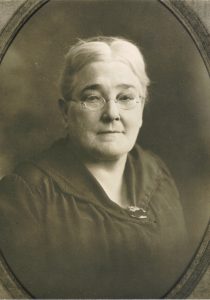 Wesley F. Martin died the morning of October 7, 1915 in his residence at 235 Garlington Street after suffering an illness lasting several months. At the time he was taken ill he was still employed by the SPUC as an inspector of the local street railway system. His funeral service was conducted in the family residence with A. A. Bristow, J. R. Smith, Tandy Walker, Thomas W. Earle, H. Berry Ingram, and J. E. Gwinn serving as pallbearers. Mattie survived Captain Martin by over two decades. After many years as a wife, mother, church member, and homemaker she passed away January 11, 1936 at the age of 81. The bodies of Wesley and Mattie await the resurrection in Springwood Cemetery. According to the Greenville Daily News obituary for Wesley, the Martins had four girls and one son surviving—Mrs. E. M. Henderson of New York, Mrs. M. E. Garrison of Easley, Mrs. Homer Dillard, and Mrs. J. H. Massey of Greenville; the son was H. Curtis Martin, of Binghamton, New York. Another son, Edward E. Martin, predeceased his parents passing away in 1912.
Barry Waugh
Notes–Through the greenlink program, Greenville is currently offering a free trolley service that is liberated from the restraints of rails and instead rolls on tires on the street. This article is rewritten from one posted December 7, 2018. Hornbaker’s book is Fall from Grace: The Truth and Tragedy of “Shoeless Joe Jackson,” New York: Sports Publishing, 2016, page 5. Also used was, Firefighting in Greenville County, 1840-1990, by W. D. Browning, Jr., 1991, pages 16, 26. The header showing the McBee Avenue Trolley circa 1920 is from the Greenville County Library System Digital Collection; Martin is not pictured. The portraits of the Martins are copies of originals provided courtesy of the church as seen in its book, Second Presbyterian Church Centennial, 1892-1992. The title of the article about Martin and the SPUC published in The Greenville News, Sunday, January 17, 1915, on page 12, is, “Southern Public Utilities Company Recognizes Merit, Have Plan for Showing Recognition of Continuous Service. Capt. W. F. Martin Has Served Co. For Fourteen Years.” Some information regarding the Martins is from Wesley’s obituary in the Greenville Daily News, Friday, Oct. 8, 1915. Neither an obituary or death notice for Mattie was located.