
 bwaugh
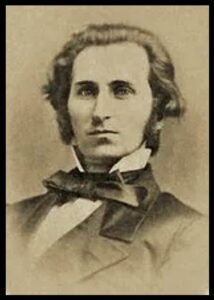 William James Hoge was born in Athens, Ohio, August 14, 1825 to Samuel Davies and Elizabeth Rice (Lacy) Hoge. Elizabeth was the daughter of a Presbyterian minister named Drury Lacy. Samuel was a minister and educator at Ohio University and the fourth son of Moses Hoge (1732-1820) who was the first professor of theology at what became Union Theological Seminary in Virginia. William’s older and only brother was Moses Drury Hoge who would be the minister of Second Church, Richmond, for over fifty years.
Hoge received his early education from his parents who found him a quick learner with voracious reading habits. He studied at Ohio University but it appears he did not graduate. It is likely his professor-minister father added to his university studies as well as tutored him in theology. Licensed in 1850 by the Presbytery of Hocking in Ohio, he soon moved to Richmond to help his brother Moses operate a female academy. His first pastoral call was to Westminster Presbyterian Church in Baltimore where he was ordained and installed by Baltimore Presbytery, August 28, 1852. A core group had set out from First Church to seed the Westminster congregation just a short time before. During this time, he married Virginia, the daughter of Rev. Peyton Harrison. Dr. Hoge’s pastorate was fruitful but to the surprise of his sad congregation he wanted to leave the church and become a professor at Union Seminary in Virginia. The pastoral relation was dissolved leaving him to transfer to the Presbytery of West Hanover and receive the call to be Professor of Biblical Introduction in Union Seminary, 1855. Then he moved from Virginia in the Spring of 1859 to become the copastor in the Brick Church in New York where he worked with the church’s senior minister who had been called since 1810, Gardiner Spring.
With the outbreak of the Civil War in 1861, then the adoption of the Gardiner Spring Resolutions by the Old School Presbyterian General Assembly that summer, Hoge was faced with a difficult choice. The Spring Resolutions required ministers and members of the Old School Presbyterian Church in the U.S.A. to swear their political allegiance to the Federal Union—this was an oath church members of the seceded states would not avow. Hoge was a Virginian ministering in New York and his work was greatly appreciated by the Brick Church congregation, but given his loyalty to Virginia he felt torn between continuing in New York or leaving for his homeland. What made his situation even more difficult was he was co-pastoring with the author of the resolutions. However, the decision was made and after his last sermon he packed up the family and headed on the risky trip to Virginia as the war spread. Soon after his arrival in Virginia he became stated supply for First Church, Charlottesville, September 1861. Included with his pastoral work was reaching out to students at the University of Virginia when they were able to attend classes because the war made keeping schedules challenging. Just two years later in October 1863 he accepted a call to the Tabb Street Church in Petersburg.
With the war in full swing, Richmond and the surrounding area including Petersburg had troops everywhere. There were prisons and hospitals in the area and a strong military presence as well as the many entities supporting the war. T. V. Moore, who was the minister at First Church, Richmond, visited hospitals holding the sick and wounded from both sides as well as the prisons with Union soldiers. Moore commented on Hoge’s wartime ministry,
Not only did he preach to the men in camp, but he invited them to his church, and when they came he assured them of a cordial welcome; addressed himself directly to them, sometimes changed the subject he had selected for one more appropriate to their circumstances, and not infrequently requesting his people to give up their pews to afford the most comfortable accommodations for his soldier hearers. The large number of soldiers attending formed a striking feature in his congregation; the galleries usually occupied by them, being so crowded, that when they rose to prayer, it looked almost like successive lines of battle. (Victory, 3-4)
Beginning in June 1864 Petersburg was under siege by Union troops with artillery fire hitting both the church and the manse next door. Seeking a safe place, the Hoges were invited to the residence of James Jones in Chesterfield about twenty miles from the church. It is not clear if he was ill when he left Petersburg or if he became ill in Chesterfield, but T. V. Moore described his disease as “a typhoid type” (p. 7). Though not an official chaplain, Hoge had visited sick and imprisoned soldiers and it is not surprising he contracted such a disease. His condition deteriorated sufficiently that the physician told the family gathered around his bed that he would not last the day. His last ministerial action was administering baptism to his four-month old son, then he requested that Revelation 7 be read and his brother complied. William James Hogg, D.D. died July 5, 1864. His funeral was held at First Church, Richmond, where T. V. Moore was the pastor. Both Moore and John Leyburn delivered sermons then he was buried in Hollywood Cemetery. The Doctor of Divinity had been given to him by Ohio University.
During his life of just shy of thirty-nine years, he did not publish much, but one work of his that was very popular is the book, Blind Bartimeus, which was first published in 1858. It is composed of sermons delivered primarily during his Baltimore call. In all 55,000 copies were published in the United States and Great Britain, as well as additional copies translated into Portuguese and modern Greek. For a full listing of Hoge’s works that are available for download including Blind Bartimeus see his entry on Log College Press.
Barry Waugh
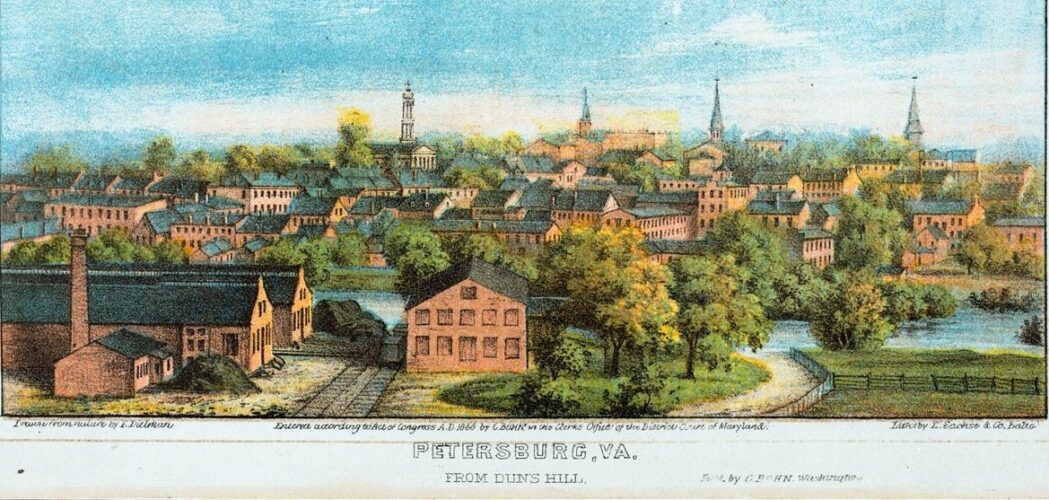
Notes—The header shows, “Petersburg, Va., from Duns Hill, 1880,” as from the New York Public Library Digital Collection. The sources used most were, T. V. Moore and M. D. Hoge, The Victory Won: A Memorial of the Rev. Wm. J. Hoge, D.D., Late Pastor of the Tabb Street Church, Petersburg, Va., Richmond: Presbyterian Committee of Publication, 1864; and Peyton Harrison Hoge, Moses Drury Hoge: Life & Letters, Richmond: Presbyterian Committee of Publication, 1899; the portrait is from this source and there is a full chapter about William, 198-229. Joseph T. Smith, Eighty Years; Embracing a History of Presbyterianism in Baltimore, Philadelphia: The Westminster Press, 1899. Gary M. Frazier, A History of Tabb Street Presbyterian Church, Petersburg: Tabb Street Presbyterian Church, 1988. Alfred Nevin, Encyclopedia of the Presbyterian Church in the United States of America Including the Northern and Southern Assemblies, Philadelphia: Presbyterian Publishing Co. 1884. Then a reference tool that comes in handy often, A General Catalogue of the Officers and Alumni of Union Theological Seminary in Virginia, 1823-24 to 1883-84, Baltimore: The Sun Book and Job Printing Office, 1884. For more about the Gardiner Spring Resolutions, see This Day in Presbyterian History on the PCA Historical Center website, “A Political Issue Divides the Old School General Assembly.”