
 bwaugh
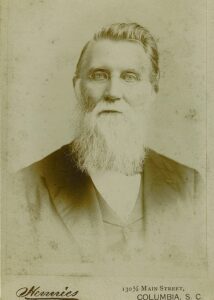 James Woodrow was born in Carlisle, England, May 30, 1828, to his minister father Thomas and his mother Marion (Williamson) Woodrow. His father completed studies at Glasgow University and was then a minster in the Orkney Islands at the northernmost extent of Scotland. In 1836 the family moved to Canada, then the following year settled in Chillicothe, Ohio, where Thomas planned to pastor the local Presbyterian congregation. He applied for transfer before Chillicothe Presbytery by submitting his credentials and testimonials from the Congregational Union of England, but since he was a foreign minister the presbytery accepted him pending one year probation supplying the 150 member Chillicothe Church. After probation he became a member of presbytery and the regularly installed pastor. When the Presbyterians divided into the Old School and New School in 1837, Thomas Woodrow maintained his membership in the Old School’s Chillicothe Presbytery while some of his colleagues went into the New School’s Ripley Presbytery. Thomas Woodrow died April 1877 after having served his life in the ministry.
Robert Galbraith said of Thomas Woodrow in The History of the Chillicothe Presbytery that he was “a fine scholar” which was a helpful attribute for supplementing his son James’s education because limited funds led to irregular attendance at the local academy. James attended Jefferson College and graduated with first honors as a member of the class of 1849. He taught school for a few years before becoming professor of natural science at Oglethorpe University in 1852, then the next year he studied with Eben N. Horsford and Louis Agassiz at the Lawrence Scientific School, Harvard University. Desiring more studies, he went to Heidelberg, Germany, to study with the renowned German chemist, Robert W. Bunsen, and there earned both an A.M. and Ph.D. Though only twenty-seven years of age, Woodrow turned down a full professorship at Heidelberg, then before returning to the States he travelled the continent and studied geology while pursuing additional studies in Naples, Vienna, Berlin, Freiberg, London, and Paris. In 1857 he was elected professor of natural science in the University of Georgia, but he turned down the position. Once again he was sought by Georgia and this time he accepted, however before he took on duties in Athens he was released so he could accept the Perkins Professorship in Columbia Theological Seminary in South Carolina.
This was a dramatic redirection for James Woodrow from creational sciences to theology especially considering that he had received no formal study in the subject. For those who are presbyters, if a candidate came before your presbytery with Woodrow’s CV how do you think the court would respond? There is no denying that he was an intelligent and gifted person given his detailed entry in Scott’s Ministerial Directory. By the time he died he had been given honorary degrees in addition to the earned ones already mentioned including the DD from Hampden-Sydney College, LLD from Davidson College, an honorary MD from the University of Georgia, and the Doctor of Canon and Civil Law from Washington and Jefferson College (they merged in 1865). Quite a variety of degrees but not one of them was in theology. Regardless of his lack of formal qualifications Woodrow was ordained in 1860.
During the Civil War, when the exercises of the seminary were interrupted, he was active in rendering services to the Presbyterian Church in the Confederate States of America (PCCSA). Then from 1865 until 1898 he was editor of the Southern Presbyterian; from 1861 until 1885 he published and edited the Southern Presbyterian Review. From 1869 until 1872 he was the professor of chemistry and geology in South Carolina College. Following a two year relocation to Europe ending in 1872 when the family returned to the United States, Dr. Woodrow continued to teach in the seminary for several years, but on May 7, 1884, at a meeting of the alumni he delivered an address that led to a controversial period of his life. He argued that evolution could be considered “God’s plan of creation” without contradicting Christian theism. He was removed from the seminary for holding views inconsistent with Scripture and the Westminster Standards, but the action was not sustained by the controlling synods of the Presbyterian Church in the United States (PCUS) and he returned to the lectern. In 1886 he was again removed, but this time by order of the synods responsible for the seminary and he would not return to teach ministerial students. Woodrow had also been teaching for some years across town in South Carolina College. The theological issues with Woodrow’s views were never fully resolved and he continued a minister in good standing in the PCUS. Woodrow continued to teach in the college until it was reorganized in 1891 and he became the college president. He retired in June 1897. Retirement did not mean inactivity because Dr. Woodrow later that summer attended at the invitation of Russia’s Czar Nicholas, II, the International Geological Congress at St. Petersburg.
In the years following his retirement he became a popular executive in the world of business, finance, insurance, railroads, and banking. Woodrow was president of the Central National Bank of Columbia, of the South Carolina Home Insurance Company, of the Carolina Loan and Investment Company, and of the People’s Building and Loan Association. He was also vice-president of the Mutual Beneficial Building and Loan Company; a director of the Columbia, Newberry, and Laurens Railroad; and of the Charlotte, Columbia and Augusta Railroad. Among the various scientific societies of which he was a member were the German Association of Naturalists, the Isis of Dresden, the Swiss Association of Naturalists, the Victoria Institute of London, and the American Association for the Advancement of Science.
James Woodrow was an active participant in the judicatories of the PCUS. He served on committees, was a commissioner in general assembly meetings, and he was a moderator. He was also for more than ten years the treasurer of the Committee of Home and Foreign Missions. His short list of publications included articles such as, “Geology and Its Assailants” (1868), “Certain Recent Assaults on Physical Science” (1873-74), “Evolution” (1884), his defense before the synod of South Carolina (1884), and his argument before the General Assembly of the PCUS that met in Baltimore (1888). His few writings show considerable interest in evolution before he was confronted regarding his alumni lecture of 1884. Dr. Woodrow was married in Dalton, Georgia in 1857, to Felle, who was the daughter of Rev. John W. Baker. James and Felle had four children. James Woodrow, Ph.D., D.D., LL.D., M.D., died January 17, 1907. And despite his removal from Columbia Seminary for his teaching about evolution and the origin of man, he was a minister in good standing.
Barry Waugh
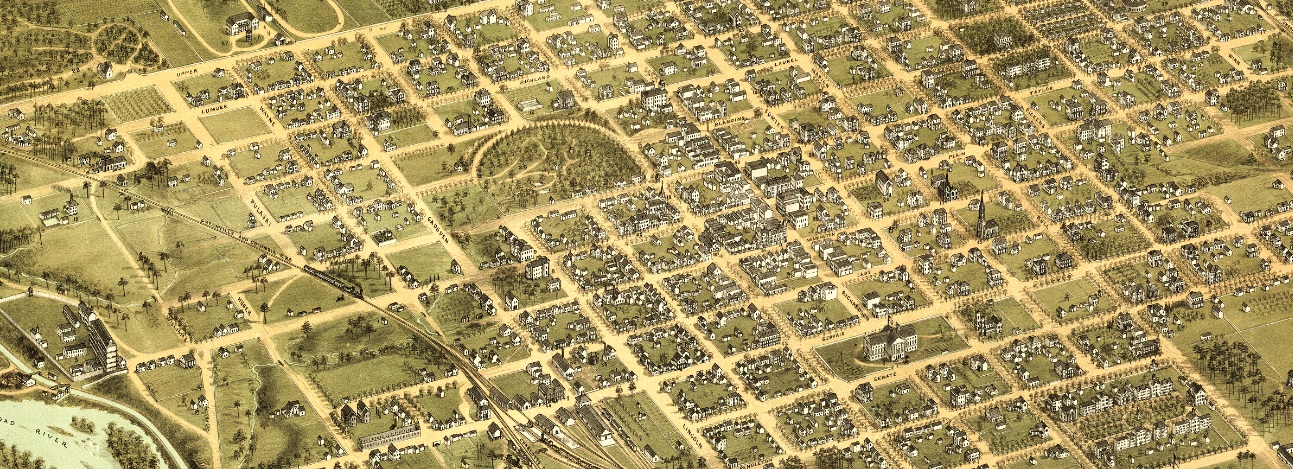
Notes–The header provides a section from the Library of Congress online collection map titled, “Bird’s eye view of the city of Columbia, South Carolina 1872.” The portrait of James Woodrow was provided courtesy of Director Wayne Sparkman of the PCA Historical Center. This Presbyterians of the Past biography is primarily adapted from his entry in The National Cyclopedia of American Biography Being the History of the United States, [etc.], vol. 11, New York: James T. White and Col, 1901, pages 35-36. A brief biography of Harvard professor Eben N. Horsford (1818-1893) is available on JSTOR, Charles L. Jackson, “Eben Norton Horsford,” Proceedings of the American Academy of Arts and Sciences 28 (May 1892-May 1893), 340-346. Information about Woodrow’s father’s ministry in Ohio was found in, The History of the Chillicothe Presbytery, by Robert C. Galbraith, Chillicothe: Gazette Book and Job Office, 1889; see pages 181-182 for the memorial for Thomas Woodrow.
Barry Waugh
For a PDF download of James Woodrow’s “One Lord, One Faith, One Baptism,” The Characteristics or Marks of the Holy Catholic Church, and the Stumbling-Blocks in the Way of those who would Enter It. Sermon Preached before the Synod of South Carolina, at Columbia, S.C., October 21, 1902, Published by Request, Columbia: R. L. Bryan Company, 1902, click