
 bwaugh
 The article by John Shirley Ward transcribed after this introduction responds to B. B. Warfield’s comments published while the Presbyterians were debating revision of the Westminster Confession in the Presbytery of New Brunswick. Ward’s views are on page ten of the Los Angeles Daily Herald, November 17, 1889. Ward was an attorney and an elder in Immanuel Presbyterian Church of Los Angeles. Later he published the pamphlet, A Common Sense View of the Westminster Confession, Los Angeles, 1894. Even though the article below is described as “No. II,” the previous article was not located.
Warfield had presented five points against revising the Confession before the Presbytery of New Brunswick, but Ward addressed only four of the five, skipping number four, however, it has been inserted into the transcription for reference. The reason Ward left out point four is not given, but it may be because Warfield’s appeal to “the Augustinian system of truth” showed the antiquity of Calvin’s doctrine with ancestry extending 1200 years. Ward’s points of contention with Warfield’s views were nothing new. He argued that several presbyteries opposed the Calvinism of the Confession and that its doctrine was out of date. Also, some candidates for the ministry were going against their consciences by subscribing to the Confession. But Warfield viewed the Confession as a summary expression of God’s revealed truth—God’s truth does not change. He added that the Confession had stood the test of time with 350 years of use by Presbyterians.
Something to consider in the revision debate is the removal of a sentence from the Confession in 1887 by Warfield and Wards’ denomination, the P.C.U.S.A. (the P.C.US. had made the same revision in 1886). This was the first revision since the newly formed P.C.U.S.A. General Assembly revised the Confession and published it in the first edition of The Constitution of the Presbyterian Church in 1789. For a century, the Confession had been used without modification despite attempts to revise its content. The revision of 1887 involved removing the last sentence of 24:4, “Of Marriage and Divorce.”
The man may not marry any of his wife’s kindred, nearer in blood, than he may of his own; nor, the woman, of her husband’s kindred, nearer in blood, than of her own.
The sentence says marriages are incestuous when they involve certain members of a deceased spouse’s kin, that is, the marriages are ones of affinity rather than consanguinity. The Scripture passages appealed to for the sentence include Leviticus 18 & 20. The revision was well supported by the presbyteries in the approval process with 156 for its removal, 11 against it, 4 presbyteries took no action, and 31 had not reported. This was a popular and decisive change to the Confession. Once the revision was made even though it involved a lesser point, it could be said that the presbyters were more likely to make additional changes since the affinity sentence had been removed. However, it would be 1903 before the Confession would be revised further with significant doctrinal changes, and at least in part, B.B. Warfield’s efforts defending the accuracy and integrity of the Confession gave it a temporary reprieve. For more on the removal of the sentence see on this site, “Colin McIver, Salkehatchie Presbyterian Church”; in the Notes section at the end, additional resources are given. See also on this site, “Presbyterians Attempt to Revise the Westminster Confession, 1891.“
Warfield had presented his paper including five points at the summer meeting of the Presbytery of New Brunswick, but it was not taken up until the fall meeting. In the intervening weeks Henry J. Van Dyke responded to Warfield in the July 31, Herald and Presbyter. Warfield’s response to Van Dyke included the five points and was published in Ought the Confession of Faith to be Revised?, 1890, which also includes articles by Princeton Seminary director, Henry J. Van Dyke; McCormick Seminary Professor of Apologetics, John De Witt; and Union in New York’s W.G.T. Shedd.
Warfield describes the Confession as “a public document” which means it is accessible to all, but the “idiosyncrasies” he speaks of refer to the exceptions subscribers might take and judicatory debates regarding its meaning.
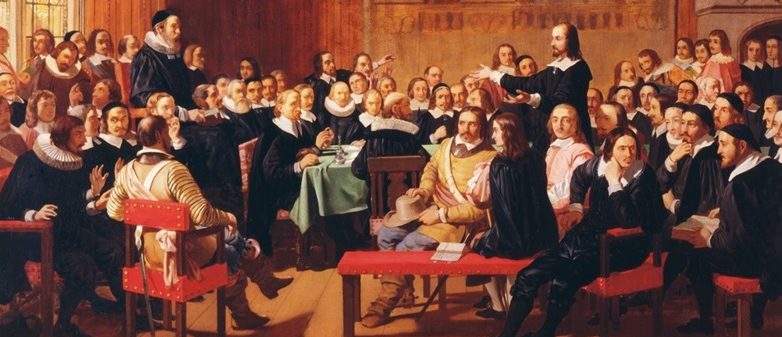
The header image is a painting of the Westminster Assembly provided courtesy of Reformation Art.
Barry Waugh
CONFESSION OF FAITH.
******************
The Westminster Confession—A Review of Dr. Warfield’s Position.
No. II BY JOHN SHIRLEY WARD
For a layman to presume to analyze or criticize the deliverance of a Princeton Professor on questions theological may be considered presumptuous, yet our great distance from the Professor geographically, and perhaps theologically, inspires us with courage to analyze some of his reasons why his Presbytery should oppose revision.
In order that our comments may be thoroughly understood we will give each of Dr. Warfield’s objections in full and follow with our comments.
Dr. Warfield says:
1.“Our free but safe formula of acceptance of the Confession of Faith, by which we ‘receive and adopt it’ as ‘containing the system of doctrine taught in the Holy Scriptures’ (Form of Government XV, 12), relieves us of all necessity for seeking each man to conform to the confession in all its propositions, to his individual preferences, and enables us to treat the Confession as a public document, designed not to bring each of our idiosyncrasies to expression, but to express the general and common faith of the whole body, which it adequately and admirably does.”
[Ward] Every officer received into the Presbyterian church adopts the Confession of Faith as “containing the system of doctrine taught in the Holy Scriptures.” Is it in strict accord with honesty and truth to say that the Confession of Faith contains “the system of doctrine taught in the Holy Scriptures,” when your mind revolts at the teaching of the Confession on the subjects of Election, Predestination and Decrees? Can we relieve ourselves of self stultification by accepting the Confession “as a public document” and not designed as an expression of “individual preference?” The Confession of Faith should be a concrete crystallization of the average theological views of those adopting or living under it.
The public faith is simply the aggregated individual faith, and whenever a Confession of Faith ceases to be the reflex or exponent of the average individual faith, it may continue for a time as a fine specimen of petrification, but destitute of the vital principle of life.
2.[Warfield] “Enjoying this free, yet hearty, relation to the Confession, we consider that our situation toward our standards is incapable of improvement. However much or little the Confession were altered we could not, as a body, accept the altered Confession in a closer sense than for a system of doctrine; and the alterations could not better it as a public Confession, however much it might be made a closer expression of the faith of some individual members among us. In any case, it could not be made, in all its propositions and forms of statement, the exact expression of the personal faith of each one of our thousands of office-bearers.”
[Ward] Dr. Warfield says, “we consider that our situation toward our standards is incapable of improvement.” If this is the sentiment of the Church, why did so many Presbyterians petition the General Assembly to open the question of revision?
There is a revolt all along the line against many forms of expression in our Confession. The strictly metaphysical forms of expression used by the framers of the Westminster Confession may be made as translucent as a sunbeam by a Princeton teacher to oar candidates for the ministry, but these same scions of Princeton, when they attempt to reconcile the teachings of our Confession on the subjects of Election, Foreordination and Decrees, with the broader and more loving gospel of Jesus and John, uniformly fail. The ordinary sinner can understand you when you quote to him the many passages from the lips of the Savior and from the gospels telling him that “God so loved the world that he gave his only begotten Son that whosoever believeth in Him shall not perish, but have everlasting life,” and that Christ by His death “atoned for every man” and that “whosoever believeth in the Lord Jesus Christ shall be saved,” but, when you quote to him the part of our Confession of Faith which says: “By the decrees of God for the manifestation of his glory some men and angels are predestined to eternal life and others foreordained unto everlasting death,” and that “these angels and men thus predestined and foreordained are particularly and unchangeably designed, and their number is so certain and definite that it cannot be either increased or diminished,” and that “the predestination unto life was made before the foundation of thee world,” and that “Elect only are saved,” and that the “Rest of mankind, God was pleased to pass by” and to “ordain to dishonor and death,” you drive him into the despair of fatalism. The Princeton Professor will answer these objections by saying, “If you only understood these things you would see the harmony between moral free agency and the decrees of God.” This is just where the trouble is. The ordinary sinner has not that power of metaphysical analysis necessary to reconcile these apparent contradictions. The result is that the average Presbyterian minister does not pretend to preach the doctrines contained in chapter 3 of our Confession. If these doctrines are not to be preached, why should they lie as a dead letter on the pages of our Confession?
3.[Warfield] “In these circumstances we are unwilling to mar the integrity of so venerable and admirable a document in the mere license of change, without prospect of substantially bettering our relation to it or its fitness to serve as an adequate statement of the system of doctrine which we all heartily believe. The historical character and the heredity value of the creed should in such a case be preserved.”
[Ward] It is the very fact that this “venerable and admirable document” does not give “an adequate statement of the doctrine which we all heartily believe” that caused thirteen Presbyteries to ask for a restatement of the creed of the Church. “The historical character and the heredity value of the creed should in such a case be preserved.” This “historical character and heredity value of the creed” would certainly have some weight if it could date back to the establishment by our Savior of His Church upon earth. Before Calvin was born, the Papacy had a “historic character,” yet we give this “historic character” no weight in our war against the Pope.
The belief that the sun revolves around the earth was a part of the “historic faith” of the Roman church for hundreds of years, and when Galileo in 1613 declared that the sun was immovable in the center of the worlds and that the earth had a diurnal motion, he was met by the anathemas of the church declaring his first, proposition “absurd in philosophy and formally heretical, because contrary to the Scriptures,” and that the second was “open to the same censure in philosophy and at least as erroneous as to faith.” “The historic character” of the divine right of kings suppressed for a long time the natural yearning of our forefathers for self-government. Age cannot deify error, nor is wrong transmuted into right by its hoary antiquity.
[4. Warfield, Point 4 is inserted here as published in Ought the Confession of Faith to be Revised?, New York: Anson D. F. Randolph, 1890. Warfield’s brief paper is in section VII of the book with the title, “The Presbytery of New Brunswick and the Westminster Confession,” on pages 39-41.
“We have no hope of bettering the Confession, either in the doctrines it states or in the manner in which they are stated. When we consider the guardedness, moderation, fullness, lucidity, and catholicity of its statement of the Augustinian system of truth, and of the several doctrines which enter into it, we are convinced that the Westminster Confession is the best, safest and most acceptable statement of the truths and the system which we most surely believe that has ever been formulated ; and we despair of making any substantial improvements upon its forms of sound words. On this account we not only do not desire changes on our own account, but should look with doubt and apprehension upon any efforts to improve upon it by the Church.”]
5.[Warfield] “The moderate, catholic and irenic character of the Westminster Confession has always made it a unifying document. Framed as an irenicon, it bound at once the Scotch and English churches together. It was adopted, and continues to be used by many Congregational and Baptist churches as the confession of their faith, been made the basis of union between the two great Presbyterian bodies, which united to constitute our church, and we are convinced that if Presbyterian union is to go further, it must be on the basis of the Westminster standards, pure and simple.
“In the interests of church union, therefore, as in the interests of a broad and irenical, modern and catholic Calvinism, we deprecate any changes in our historical Standard, to the system of doctrine contained in which we unabatedly adhere, and with the forms of statement of which we find ourselves in hearty accord.”
[Ward] The unifying power of the Westminster Confession has not been very conspicuous thus far. The Congregational Church has been so much unified as to leave us, and the Baptist church is as far from us as at any time since its existence. The Cumberland Presbyterian Church, now 165,000 strong, was driven off by the centrifugal dynamite embodied in chapter 3 of this same unifying Confession. The fact of the union of the New and Old School branches of the Presbyterian Church proves nothing, as both used the Westminster Confession, with slightly different constructions during the time of their separation.
Dr. Warfield’s objections may be briefly summarized as follows:
First, That the Confession is a “Public Document” designed to express the “general common faith of the whole body” allowing the right of private interpretation.
Second, That our situation toward our Standards is incapable of improvement.
Third, The historical character and heredity value.
Fourth, Because he has no hope of bettering the Confession either in the doctrine it states or in the manner in which they are stated.
Fifth, Its unifying power, being a basis for a union of all churches.
To all these objections we replay that we favor a revision.
First, Because our Confession does not correctly state the present religious thought of the Church.
Second, Because there is a wide variance between Presbyterianism as taught from the pulpit and as embodied in our Confession.
Either let us adapt our preaching to our Confession of Faith, or so modify our Confession as to make it harmonize with our preaching.
Los Angeles, Cal. August 1, 1889.