
 bwaugh
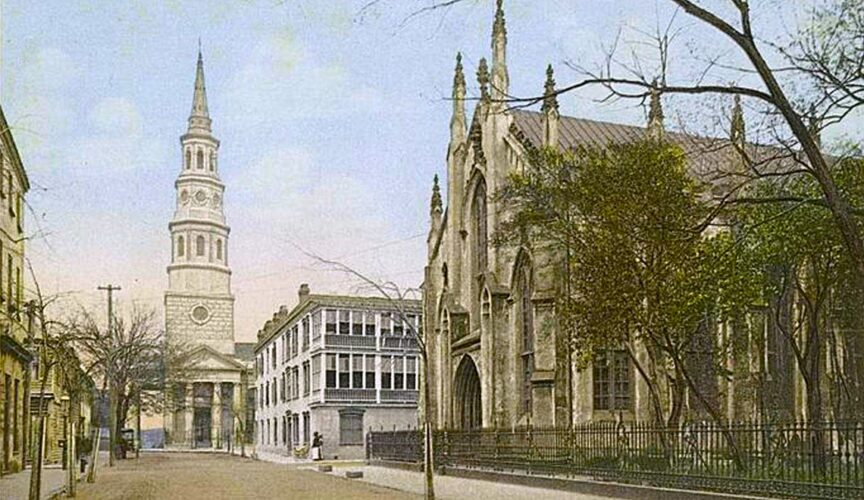
 The Huguenot Church at the corner of Queen and Church Streets in Charleston provides a place of worship for the only extant Huguenot congregation in the United States. Its continued presence is a reminder of the importance of French Reformed Protestantism for the history of Charleston and the state of South Carolina. Huguenots began leaving France in 1685 due to revocation of the Edict of Nantes by Louis XIV. The edict had granted a degree of religious liberty for Protestants when it was enacted in 1598. Roughly four-hundred-thousand Huguenots emigrated to England, Holland, and Ireland, as well as to South Carolina, Florida, and New York in the United States. Some historians believe these emigrees were some of France’s most gifted minds and talented entrepreneurs. Charleston’s French influences are seen throughout the city with street names such as Gillon, Beaufain, Gendron, Vendue Range, Cordes, Legare, Laurens, and Huger as well as in historical tourist attractions such as the home of the plantation owner Joseph Manigault. As the years passed some Huguenots with their Reformed doctrine departed the Charleston port of entry and moved to other areas of South Carolina where they worked hard and enjoyed successful business enterprises including those in later years associated with the textile industry.
One person of Huguenot descent was David Xavier La Far who was born in Charleston November 2, 1826. He remained in his hometown for education attending the College of Charleston and graduating head of his class of seven students in 1846. Another South Carolinian of Huguenot ancestry was John L. Girardeau who graduated the College of Charleston in 1844 and went on to be a minister and seminary professor. La Far studied law with the intention of establishing his own practice but came to realize he was instead called to the ministry, so he laid aside reading law for Scripture and theology books. It is not clear how he obtained a ministerial education but it may be that the pastor of the Huguenot Church at the time, Charles Wallace Howard, tutored him in the subjects required. Howard was a Presbyterian minister from Georgia who served the Huguenot Church beginning in 1845. During Howard’s ministry the current church building was opened for regular services Sunday, May 11, 1845, with the sermon text Psalm 124:8,
Our help is in the name of the Lord, who made heaven and earth.
But in 1849 due to health concerns and a need for convalescence, Howard rested from ministry by taking an extended trip to Europe. When he returned to Charleston he tried to resume pastoral work but could not take on all the responsibilities required by his call. Thus, young La Far assisted Howard. In February 1850 while Pastor Howard continued to convalesce, the congregation asked La Far to supply the pulpit for a period of one year.
After serving his home church D. X. La Far moved about seventy-five miles northwest from Charleston to Orangeburg to become pulpit supply for the Presbyterian Church from July 1851 to January 1856. Information about La Far is limited but it is known that he was back in Charleston on April 1, 1860 to attend the installation of Thomas O. Rice as pastor of the Congregational Church (Circular Church) in Charleston. Also in attendance with La Far was his Charleston College campus colleague John L. Girardeau; Thomas Smyth, who pastored nearby Second Presbyterian Church; and other Presbyterian notables such as Gardiner Spring, who had travelled all the way from New York for the installation. In 1861, “The Spring Resolutions” would be presented to the General Assembly of the Presbyterian Church in the United States of America (PCUSA), Old School, which would lead to churches in the Confederacy leaving to form the Old School Presbyterian Church in the Confederate States of America (PCCSA). It is known that La Far, according to the 1861 census of Charleston, owned a frame house on a lot on West Street at number 8, but at the time, he was renting it to a tenant named Jesse Russel. It is believed that La Far left Charleston just after the Civil War began and likely rented the house during his absence.
D. X. La Far was ordained in 1863 and the sources consulted made no mention of his having been previously licensed, but he was likely licensed given the thirteen years of intermittent pulpit supply before he was ordained. His first ordained ministry was supplying the First Presbyterian Church in Anderson, 1863-1864, then he served the Varennes Church, 1864-1866, and by about 1871 he was supplying the Laurel Street Chapel which appears to have been a Black congregation. Currently, the Francis Brown African Methodist Episcopal Church is on what was Laurel Street which is currently named Ashe Street. Louisa Cheves Stoney, who edited her grandfather’s Autobiographical Notes, Letters and Reflections by Thomas Smyth, D.D., 1914, noted that the Laurel Street Chapel was in her day “African Methodist.” One of La Far’s obituaries mentioned that he did some mission work in Charleston in his earlier years which could have included the Laurel Street work.
A considerable gap in the records extends for more than a decade during which time it is believed La Far was primarily teaching school in Charleston and supplying churches as needed. He was especially adept at teaching German, Latin, and Greek. The Presbyterian Church documentation of his ministerial efforts restarts with Tirzah Church, December 1883 to November 1884, followed by Beulah Church, 1885-1886, and then the Lynchburg Church for several months in 1892. At some point he supplied the Fair Hope Presbyterian Church in Lamar, Darlington County, which was founded in 1872 but the specific dates of his ministry have not been determined. He was also associated with the Brewington Presbyterian Church located about nine miles from Manning and his last pastoral work was serving two congregations, the Richmond Church, founded in 1885, and the Corinth Church, founded 1886.
Due to health problems La Far went to Brevard, North Carolina where he hoped to find relief from the late summer humidity and heat prevalent in the South Carolina Low Country. However, the attempt to ease his symptoms was to no avail because he passed away August 24, 1897. Even though he had not been well his death was unexpected. His body was returned to the Low Country and his funeral was led by Rev. John Gordon Law, who served the Presbyterian Church in Darlington. He is buried in the cemetery of the Huguenot Church in Charleston next to his firsst wife, Mary Wetmore Robertson of Connecticut, who predeceased him, October 6, 1878. His second wife, Martha Nelson Bartlett, survived him dying February 24, 1920 and she is buried in the Sumter Cemetery, Sumter, South Carolina. A third grave marker in the plot with La Far and Mary may be for a child. Inscribed on his grave marker is, “A faithful pastor, a devoted husband, and father.”
The minutes of the Synod of South Carolina of the Presbyterian Church in the United States (PCUS) for 1898 published a biographical memorial for their colleague and friend that was concluded with the following words from James Montgomery’s hymn, “Servant of God, Well Done,” 1816.
Rev. La Far, even though a Huguenot descendant, had spent much of his life as a Presbyterian minister. As the Huguenot generations in America have passed some French Reformed South Carolinians found the Calvinism of Presbyterians a suitable alternative to their own confessional doctrine. Particularly in South Carolina it is not uncommon to find several French surnames in Presbyterian cemeteries and when reading congregational histories pastors with Gallic names are often mentioned.
Barry Waugh
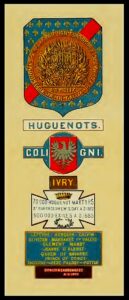
Notes—The header is snipped from a postcard titled, “Huguenot and St. Philip’s Churches, Charleston, S. C.,” as published by the Detroit Publishing Company, circa 1915, and it is from the New York Public Library Digital Collection. The Huguenot Church is on the immediate right with St. Phillips Episcopal at the end of the street. The Huguenot banner was used for the Tercentenary Celebration of John Knox’s death (1514-1572) held in Philadelphia in 1872; the banner was located at the end of Nevin’s Encyclopedia of the Presbyterian Church, 1884. The black border was added for contrast with the page background.
Articles on Presbyterians of the Past about Huguenotes inculude: “James F. Gibert, Huguenot Presbyterian Minister”; “André Guillebeau, Jean Louis Gibert, & the New Bordeaux Huguenots”; “Nash Le Grand, ca. 1768-1814”; and “Florida Huguenot Trail.” Also relevant to Huguenot history are the article about J. H. Merle D’Aubigné who wrote a multi-volume history of the Reformation, and a missionary to the Chinese named Augustus W. Loomis. The PCCSA was named Presbyterian Church in the United States (PCUS) after the Civil War ended. Howard’s dedicatory sermon for the Huguenot Church is titled, A Sermon, Delivered at the Re-Opening and Dedication of the French Protestant Church of Charleston, S.C., on Sunday, the 11th Day of May, 1845. Internet Archive has some other publications relevant to the Huguenot Church and South Carolina Huguenots. Presbyterian reference books consulted include Scott’s Ministerial Directory of the PCUS; the historical works of Jones and Mills (1 vol.) and George Howe (2 vols.) about the South Carolina Presbyterian Church; J. B. Martin’s Guide to Presbyterian Ecclesiastical Names and Places (invaluable for discerning proper Presbyterian entity identities), and several newspaper obituaries located on the Library of Congress site. The memorial for La Far by the Synod of South Carolina is available in Minutes of the Synod of South Carolina, at its annual meeting, held at Darlington, S. C., October 29th-November 1st, 1897. Information about the installation service at Circular Church in Charleston was located in the Complete Works of Thomas Smyth, D.D., vol. 6. There is an index to Smyth’s works available in PDF on the PCA Historical Center website, and Internet Archive has the ten-volume set of Smyth’s works in digital form.