
 bwaugh
Joseph Davis was born May 30, 1828 to David and Jane (Davis) Smith at Moys, Londenderry County, Ireland. When he was nineteen years of age his parents and three siblings—William, David, and Martha—moved to America where they joined the multitude of immigrants seeking new lives in the United States. The Smiths settled in Philadelphia where Joseph received preparatory studies with Dr. Robertson, then contined work at Centre College, Danville, Kentucky. He was skilled with English and Mathematics which combined with his experience in the printing business gave him tools he could use while at Centre. However, it appears things did not work out as well as he had hoped because he lived in Kentucky for just a few years but it was long enough for him to complete the freshman year at Centre College in Danville. Leaving Kentucky he returned to Pennsylvania and graduated Jefferson College in Canonsburg in 1856. Joseph professed faith in Christ in the Union Presbyterian Church of Philadelphia when he was 22.
Having been called to the ministry, Smith entered Princeton Seminary and completed the full three-year program in 1859. He was licensed October 30, 1860 by the Presbytery of Philadelphia and tested his ministry skills supplying churches for a little over a year. One of the churches he preached in was Slate Ridge in Peach Bottom, Pennsylvania, on the Susquehanna River. The church had been having a difficult time locating a minister during the four years since the previous minister, Samuel Parke, who had served the church for over forty years, resigned his call. Contributing to the factors making finding and calling a pastor challenging was the church was located about a quarter mile from the Mason and Dixon line; the increasing tensions regarding issues that would lead to war were making the border between North and South a chancy place to settle. However, Licentiate Smith accepted the opportunity, and was ordained, then installed pastor of the Slate Ridge Church by the Presbytery of Donegal, October 30, 1860. The following spring, the Civil War began and young Smith found himself the pastor of a congregation meeting in a church within a stone’s throw of the line dividing the Union from the Confederacy. Along with starting the pastorate that would be his only call, the year 1860 saw the death of his father.
In presbytery, Smith was for several years chairman of the theological examining committee and was known for his capable and knowledgeable testing of candidates for licensure and ordination. He was three times a commissioner to the General Assembly of the Presbyterian Church in the United States of America (PCUSA), Old School. He first attended a general assembly as a commissioner from Donegal Presbytery when it convened in Cincinnati in 1867. The Cincinnati meeting was a challenging one partly due to business related to the reunion of the Old and New Schools slated for 1869. In 1870, the Donegal Presbytery boundaries were modified as part of the reorganization of the denomination after the Schools reunited, so when Smith attended his second assembly in Brooklyn in 1876, he did so as a commissioner from the newly organized Westminster Presbytery. At the time the assembly convened on May 18 the Centennial Exposition had just opened in Philadelphia with its 285 acres of attractions to commemorate the independence of the United States. The Assembly had often rebuked the government over the years for failing to uphold the Sabbath, but in 1876 the assembly passed an extended resolution praising the Centennial Commission for closing on the Lord’s Day. The resolution was hand delivered to the Centennial Commission by a committee with each of its thirteen members representing one of the original colonies. Smith’s final work as an assembly commissioner was in the scenic area north of Albany, New York, in the First Presbyterian Church of Saratoga Springs in 1884. He was appointed to serve on the Standing Committee on Aid for Colleges and Academies by Moderator George P. Hayes, D.D., LL.D.
As the years passed, Smith enjoyed a steady ministry and an increase in the congregation. The church communicant membership numbered 105 when he was installed the pastor and by the time his call was dissolved in 1890, the flock numbered 150. He had a keen interest in the study of Greek and often tutored locals in the language, and he, as so many ministers did, tutored individuals to prepare them for college. During his ministry at Slate Ridge, he had a few of his sermons published in 1868, also published was his An Historical Discourse Relating the Origin and History of the Slate Ridge Presbyterian Church in Peach bottom, York County, Pennsylvania. His pastoral relation with the Slate Ridge Church was dissolved April 8, 1890. Even though he was retired, he continued to fill local pulpits and work with the extended church as a presbytery evangelist while residing on his tract of land abutting the church property.
The circumstances of his death were unusual but probably not uncommon for those in rural areas. The Oxford Press for Thursday, December 27, 1906, reported,
Barry Waugh
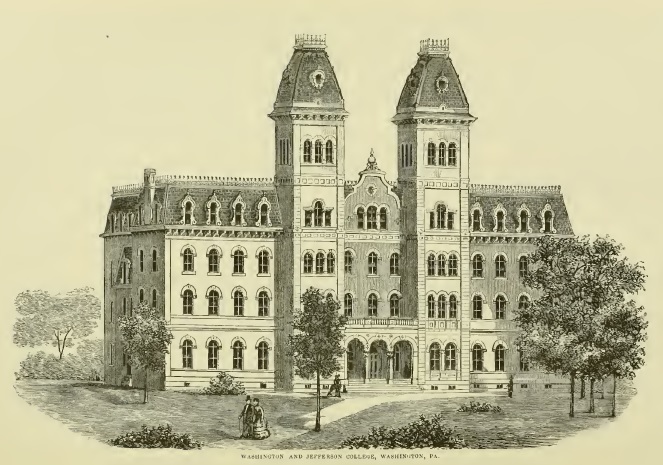
Notes—The header shows Washington and Jefferson College. The two colleges merged in 1865. A portrait is available on the Find-a-Grave page for Smith. Moderator of the 1884 General Assembly, George P. Hayes wrote, Presbyterians: A Popular Narrative of their Origin, Progress, Doctrines, and Achievements, New York: J. A. Hill & Co., 1892. Sources used include: The Princeton Seminary Necrological Reports for 1907; Lorenzo R. Clark, History of Centre Presbyterian Church, New Park, Pa., 1790-1903, 1903; the Princeton Seminary Necrological Report; S. T. Wiley, ed, Biographical and Portrait Cyclopedia of the Nineteenth Congressional District, Pennsylvania, Containing Biographical Sketches of Prominent and Representative Citizens of the District Together with an Introductory Historical Sketch, Philadelphia, 1897; vol. 2 of, History of York County Pennsylvania, Biographical, Illustrated, Chicago: J. H. Beers, 1907, page 420. Also accessed were Smith’s history of Slate Ridge Church, minutes of the General Assembly of the PCUSA for the years mentioned, and A History of the Presbytery of Westminster and its Antecedents, 1732-1924, Chicago: The Reagan Printing and Publishing Company, 1924. The church is currently located in Maryland because it moved a few years after Smith resigned his call.