
 bwaugh
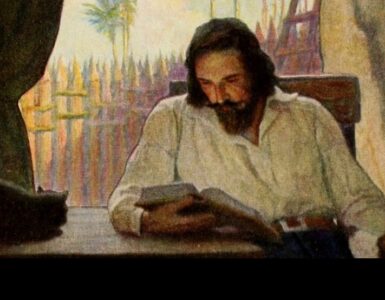
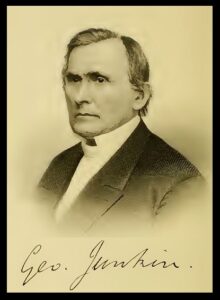 George was born November 1, 1790, to Joseph and Eleanor (Cochran) Junkin on the family farm near Harrisburg, Pennsylvania. Eleanor Junkin was surely a busy mother because her fourteen children would have required every second of every day. Eleven of the ten sons and four daughters survived to marry and have their own families. One of his considerably younger brothers, David, would become known as D. X. Junkin and a Presbyterian minister like George. Joseph was a prosperous farmer as well as a successful entrepreneur who operated a mill, ferry service, and other businesses. George’s early education was provided by William Jamieson. Everyone in town recognized Master Jamieson because he walked with a crutch. The local children gathered for class in a log school house about a mile and a half from the Junkin home. Along the two longest walls of the log school were log-high gaps above the students’ desks that allowed them to see outside and enjoy the Pennsylvania scenery as they labored over their books. In some cases in the era log school houses were used as miniature forts and the horizontal openings facilitated the use of firearms by community members while protected from atackers. George said of his teacher that he was “a beautiful penman, a pretty good teacher, truly benevolent, and therefore greatly beloved.” After Master Jamieson’s teaching, George received additional instruction from a succession of teachers. He completed his studies and hoped hat he could at some point go to college.
As he anticipated the possibility of further education, the family moved west about 250 miles from their Harrisburg area home to a more remote location on Hope Farm near Mercer. For three years George worked intermittently as a carpenter, jointer, farmer, sawyer, miller, and carder. He commented that on his family’s farm it was common to see the harvesters drinking whiskey as they cut and gathered the grain—keep in mind that the instrument for harvesting grain was a razor-sharp scythe (see, at the end of this post regarding the Whiskey Rebellion). After a few years, his interest in college studies led him to discuss with his father additional education. Joseph was opinionated and particularly against his son going to college. However, his mother interceded and convinced her husband that college would be good for George, so he entered Jefferson College in Canonsburg, south of Pittsburgh, beginning studies with a heavy dose of remedial Latin. He pressed on through the full curriculum, completed his examinations, and graduated in September 1813.
During George’s college years, he professed faith in Christ and came to believe he was called to the ministry. The month after graduation he left home and headed east for New York to study in the Associate Reformed Seminary operated by John Mitchell Mason (1770-1829). He traveled on horseback crossing the Susquehanna River by ferry at Harrisburg, then proceeded to Lancaster where upon arrival he auctioned his horse and tack before taking the stagecoach to Philadelphia. When he arrived in Philadelphia he met a young man named John Knox—a good name for a Presbyterian seminarian—who was returning to Mason’s seminary for the second year. After a few days in Philadelphia, the students boarded a stagecoach headed for New Jersey and the next day continued on to New York. The years in New York required some adjustments for George as he transitioned from rural western Pennsylvania life to the challenges of living in the big city.
Having completed divinity studies in 1816, George and three of his seminary colleagues set out in a wagon for ministry opportunities in western Pennsylvania. They arrived in Noblestown in Allegheny County for the meeting of the Associate Reformed Presbytery of Monongahela. He was examined for licensure and all his views were determined satisfactory except for one point regarding the Lord’s Supper—he did not hold to closed communion (only members in good standing of the particular church, presbytery, or synod may participate in the sacrament). The presbytery refused to license him to preach, so he asked if he could be licensed instead by the Big Spring Presbytery, which was another presbytery of the Associate Reformed Synod. Instead of granting the request, Monongahela Presbytery reconsidered its decision and granted him a license. He delivered his first sermon in Butler, September 17, 1816. After several experiences testing his gifts for the ministry in various pulpits he was ordained an evangelist June 29, 1818. He supplied the church in Newville briefly and was offered a call, but turned down the opportunity due to an inadequate salary and because many in the congregation, in his opinion, drank too much whiskey. While supplying the pulpit of the church in Milton, the church came to appreciate his ministry enough to offer him a pastoral call that was accepted. During the Milton years he married Julia Rush Miller of Philadelphia, June 1, 1819. He not only shepherded his flock but was also involved in founding a local academy, publishing The Religious Farmer (1828-1829), and working with mission, Bible, education, and temperance societies. His participation in the temperance societies may have been motivated by problems in his congregation and in other local churches. He commented regarding the Milton Church,
Whiskey drinking was almost universal. A funeral even could not be conducted without the circulation of the bottle and the tumbler. Elders of the church deemed it not inconsistent with their Christian profession or their official position, to engage in the manufacture and sale of whiskey.
Pastor Junkin cared for his congregation and continued ministry in the Milton Church for eleven years before leaving pastoral ministry for educational work.
Junkin’s continued interest in and gifts for education resulted in his election in 1830 to the presidency of the Pennsylvania Manual Labor Academy located in Germantown which is currently a part of the city of Philadelphia. The position was accepted and in early August the Junkins moved to their new home. But his tenure was brief because he was elected to and accepted the presidency of Lafayette College in spring 1832. However, the trouble was, Lafayette College did not exist and was merely in the planning stages. The board was hopeful that Junkin had the ability to develop their vision for the new college to be located in Easton. Up for the challenge, he accepted the appointment, moved once again, and took with him the Pennsylvania Manual Labor Academy to become a part of the student body.
During his time of service to Lafayette College, Junkin became concerned about doctrinal issues taking place in the Presbyterian Church in the United States of America (PCUSA). While in Milton, he left the Associate Reformed Synod to become a member of the Presbytery of Northumberland of the PCUSA, but since his move to Germantown he was a member of Second Presbytery of Philadelphia. Another member of his presbytery was the minister of First Presbyterian Church, Philadelphia, Albert Barnes, who expressed theological views in his books that Junkin and others found contrary to the church standards. Joining others, Junkin brought charges against Barnes to presbytery, he was acquitted, but then on appeal to the synod he was found guilty and suspended from the ministry. The final appeal was to the PCUSA General Assembly which by a close vote reversed the decision of the synod and restored Barnes to ministerial duties. The assembly concluded that the problem with Barnes’s teaching was a poor choice of words in his writings resulting in the impression that his teaching was not orthodox. Dr. Barnes was advised by the assembly to be more precise with his terminology. This decision was not well received by Junkin nor some other members of the PCUSA, and the Barnes case became a factor contributing to the division of the denomination into the Old and New Schools in 1837.
Having built Lafayette College from the ground up, President Junkin was then unanimously elected by the Board of Trustees of Miami University in Ohio to become its next president in 1841. The Miami trustees were concerned that he should restore proper discipline and increase the quality of the curriculum. During his few years in Ohio, Junkin worked to fulfill the board’s mandate but meanwhile back at Lafayette some were meeting with hopes of returning him to the president’s office. During 1844, the same year he was moderator of the Old School General Assembly, Junkin was re-elected president of Lafayette and returned to Easton to begin in the fall. Under his administration the College steadily grew, but as with so many of the educational institutions of the day, Lafayette continued to have difficulty raising sufficient funds to maintain its campus and improve its programs.
Knowledge of Junkin’s gifts as an administrator had spread to other areas of the nation resulting in several schools seeking his leadership. In 1848, Washington College in Lexington, Virginia, elected him president. He accepted the position, packed up the family in Easton and moved south to Virginia. As his work progressed the issues that would result in secession and the Civil War were increasing. His family had grown to love Virginia but when the war neared he found himself torn between personal political convictions and the difficult situation that was developing. Two of his daughters married professors in the Virginia Military Institute who were also officers in the Lexington Presbyterian Church. Eleanor married Deacon and Major Thomas J. Jackson in 1853, and then passed away with her infant child about a year later; the second daughter, Margaret, had married Elder and Colonel J. T. L. Preston. With the onset of war, Dr. Junkin, who was opposed to secession, reluctantly decided to relocate the family North.
George Junkin was over seventy years old when he packed up the family property to head across the Mason-Dixon Line into Pennsylvania. He drove the family carriage through Williamsport and Hagerstown in Maryland, then on to Chambersburg. During the war and through his last years he continued to serve the church by supplying pulpits, supporting the temperance movement, and promoting Sabbath observance. George Junkin died of angina pectoris, May 20, 1868. The last sermon text he is known to have preached was John 14:1, “Let not your hearts be troubled. Believe in God; believe also in me.” His wife Julia had died February 23, 1854, from a protracted and painful disease. Julia and George had nine children. George Junkin was honored with the Doctor of Divinity (D.D.) by Lafayette College in 1833, and then in 1856, Rutgers College honored him with the Doctor of Laws (LL. D.).
A few of Junkin’s several publications include An Address Delivered by Special Request Before the Theological Society in the Theological Seminary, Princeton, N. J, Philadelphia, 1833; A Treatise on Justification, Philadelphia, 1839; On Decision of Character: The Baccalaureate in Miami University, Rossville, 1844; Christianity, The Patron of Literature and Science, Philadelphia, 1849; An Apology for Collegiate Education: Being the Baccalaureate Address, Delivered on Commencement Day of Washington College, Lexington, 1851; The Baccalaureate Address, Delivered on Commencement Day of Washington College, Richmond, 1852; Civil Government an Ordinance of God: A Lecture for the Times, Philadelphia, 1861; A Treatise on Sanctification, Philadelphia, 1864; The Two Commissions: The Apostolical and the Evangelical, Philadelphia, 1864; The Tabernacle, Or the Gospel According to Moses, Philadelphia, 1865; and A Commentary Upon the Epistle to the Hebrews, Philadelphia, 1873. These and other publications by Junkin are available in PDF for free from Log College Press.
Barry Waugh
Whiskey Rebellion—In 1794, farmers in the western part of Pennsylvania were involved in the “Whiskey Rebellion.” The unrest began in 1791 when the yet young U. S. Congress passed an excise tax on spirits. Many frontier Pennsylvanians grew grain, much of which was distilled into whiskey. The western farmers said they could not successfully sell their crops as harvested because of the cost of and damage caused by shipping to the large eastern markets, thus whiskey and other spirits were more profitable and less bulky. It also seems, as George Junkin observed twenty-years later, there was a problem with abuse of the liquid crop by the farmers themselves. Those involved in the Whiskey Rebellion believed the tax was another example of the eastern elite showing indifference to the needs of those on the frontier. President Washington issued an order in 1792 reaffirming the need to pay the tax, but trouble continued until violence erupted in Pittsburgh in 1794. Commander and Chief Washington led over 12,000 militia to suppress the unrest. It should be noted here that President Washington entered the distillery business himself in 1797 and by the time of his death in 1799 he was producing 11,000 gallons per year making him the largest distiller in the United States. The tax was not repealed until the presidency of Thomas Jefferson in 1802. Thus, President Washington enforced a national tax that he himself would have to pay when he went into the spirits business at Mt. Vernon. The informative website for Mt. Vernon was the source for most of this information.
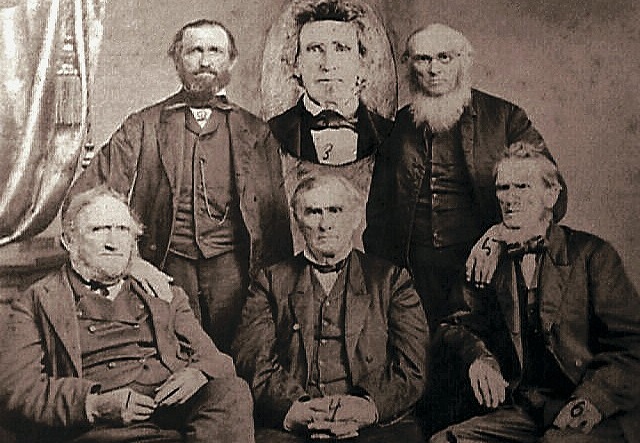
Notes—D. X. (David Xavier) Junkin wrote a lengthy biography of his brother titled, The Reverend George Junkin, D.D., LL.D., A Historical Biography, Philadelphia: J. B Lippincott & Company, 1871; this book provided information for this biography and the signed portrait is the frontispiece; the quote in the second paragraph of this biography is from page 30; and the one about whiskey in his congregation is on page 88. The header picture is dated 1865 and was provided courtesy of the PCA Historical Center, Wayne Sparkman, director. It shows six Junkin brothers at a reunion including an inserted portrait for Joseph who was either deceased or unable to attend–back row left to right, Matthew, Joseph, and David; front row left to right, Benjamin, George, and William F. The spelling of George’s mother’s name, Eleanor, is based on the spelling in his biography; some sources spell it Elinor. The Sam Houston Historic Schoolhouse in Maryville, Tennessee, is a log structure with horizontal windows like those in the school Junkin attended. Another Presbyterian associated with Miami University and written about on Presbyterians of the Past is William H. McGuffey, America’s Educator. When Junkin’s daughter Eleanor died, her husband Deacon T. J. Jackson considered marrying her sister, Margaret, but decided against it due to the prohibition against such marriages in the Westminster Confession of Faith, 24:4. As a Presbyterian Church officer he had vowed to uphold and follow the confession. For an examination of this and other near-kin marriage issues in Presbyterian history see the author of this site’s, The History of a Confessional Sentence, 2002, which studies the relevant sentence in the Westminster Confession, chapter 24, “Of Marriage and Divorce,” and is provided free by the author through Log College Press in PDF.